
Ch.6 - Electronic Structure of Atoms
Brown - Chemistry: The Central Science 14th Edition
Brown14th EditionChemistry: The Central ScienceISBN: 9780134414232Non è quello che usi tu?Cambia libro di testo
Capitolo 6, Problema 100a

The Chemistry and Life box in Section 6.7 described the techniques called NMR and MRI. (a) Instruments for obtaining MRI data are typically labeled with a frequency, such as 600 MHz. In what region of the electromagnetic spectrum does a photon with this frequency belong?

Guida verificata passo dopo passo
1
Identify the frequency given in the problem, which is 600 MHz. Convert this frequency into hertz (Hz) for standard calculations. Since 1 MHz = 10^6 Hz, multiply 600 by 10^6 to get the frequency in Hz.
Recall the electromagnetic spectrum and the typical frequency ranges for different types of electromagnetic radiation. The main regions include radio waves, microwaves, infrared, visible light, ultraviolet, X-rays, and gamma rays.
Understand that NMR (Nuclear Magnetic Resonance) and MRI (Magnetic Resonance Imaging) typically use radio waves, which are at the lower frequency end of the electromagnetic spectrum.
Compare the converted frequency (in Hz) to the known frequency ranges of the electromagnetic spectrum. Radio waves generally have frequencies ranging from about 3 kHz to 300 GHz.
Conclude that a frequency of 600 MHz falls within the radio wave region of the electromagnetic spectrum, as it is well within the range of radio frequencies.

Risposta video verificata per un problema simile:

Questa soluzione video è stata consigliata dai nostri tutor come utile per risolvere questo problema.
Durata del video:
2m

Concetti chiave

Ecco i concetti essenziali che devi comprendere per rispondere correttamente alla domanda.

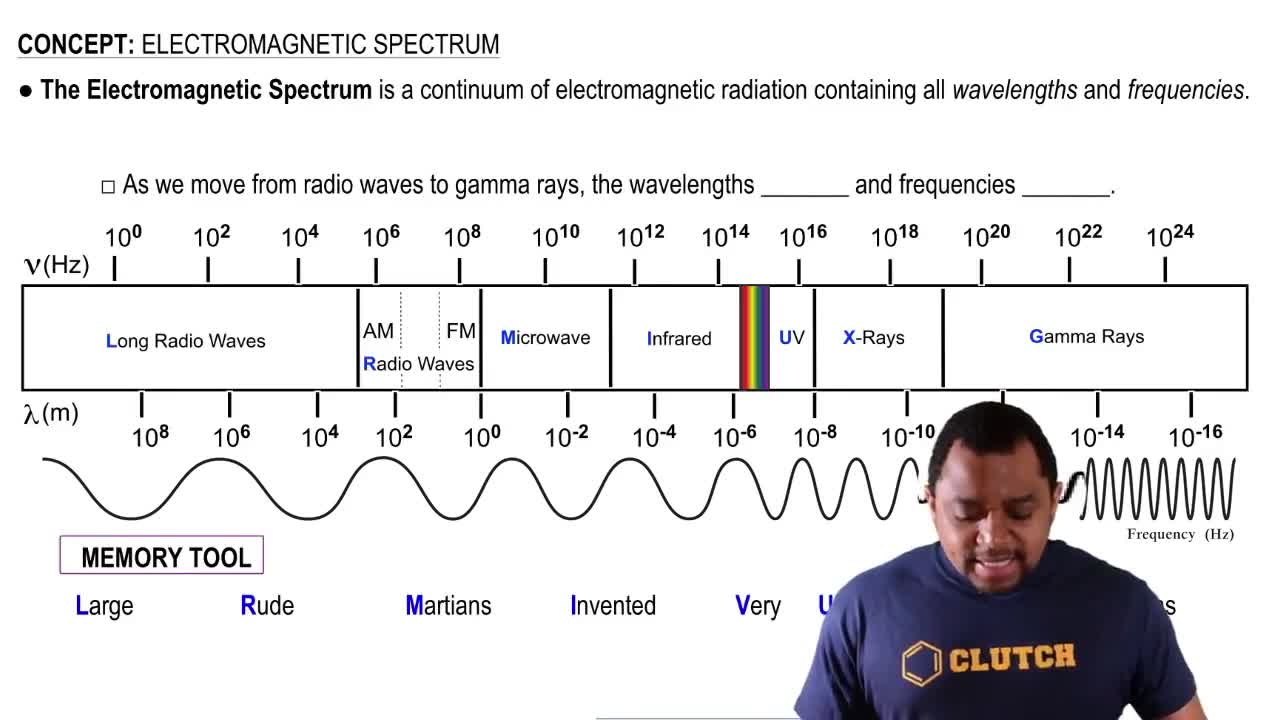
Electromagnetic Spectrum

The electromagnetic spectrum encompasses all types of electromagnetic radiation, which vary in wavelength and frequency. It ranges from radio waves with long wavelengths to gamma rays with very short wavelengths. The spectrum is divided into regions, including radio, microwave, infrared, visible light, ultraviolet, X-rays, and gamma rays, each with distinct properties and applications.
Video consigliato:
Percorso guidato
02:53
Electromagnetic Spectrum

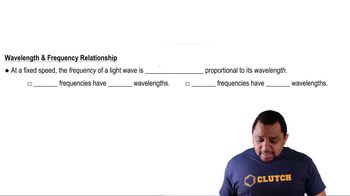
Frequency and Wavelength Relationship

Frequency and wavelength are inversely related properties of electromagnetic waves. The frequency (measured in hertz) indicates how many wave cycles pass a point per second, while wavelength (measured in meters) is the distance between successive peaks of the wave. This relationship is described by the equation c = λν, where c is the speed of light, λ is the wavelength, and ν is the frequency.
Video consigliato:
Percorso guidato
00:31
Frequency-Wavelength Relationship

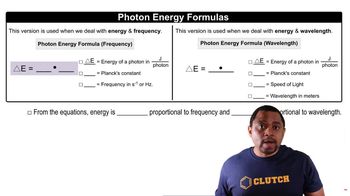
Photon Energy

A photon is a quantum of electromagnetic radiation, and its energy is directly proportional to its frequency. The energy of a photon can be calculated using the equation E = hν, where E is energy, h is Planck's constant, and ν is frequency. Higher frequency photons, such as those in the MRI range, carry more energy compared to lower frequency photons, which are found in radio waves.
Video consigliato:
Percorso guidato
01:40
Photon Energy Formulas