
Ch.7 - Periodic Properties of the Elements
Brown - Chemistry: The Central Science 14th Edition
Brown14th EditionChemistry: The Central ScienceISBN: 9780134414232Non è quello che usi tu?Cambia libro di testo
Capitolo 7, Problema 31d

Consider the isoelectronic ions F- and Na+. (d) For isoelectronic ions, how are effective nuclear charge and ionic radius related?

Guida verificata passo dopo passo
1
Understand that isoelectronic ions have the same number of electrons but different numbers of protons.
Recognize that effective nuclear charge (Z_eff) is the net positive charge experienced by an electron in a multi-electron atom, calculated as Z_eff = Z - S, where Z is the atomic number and S is the shielding constant.
For isoelectronic ions, the ion with the higher atomic number (more protons) will have a higher effective nuclear charge because the shielding effect is similar, but the nuclear charge is greater.
A higher effective nuclear charge results in a stronger attraction between the nucleus and the electrons, pulling the electron cloud closer to the nucleus and resulting in a smaller ionic radius.
Apply this understanding to F^- and Na^+: Na^+ has more protons than F^-, so it has a higher effective nuclear charge and a smaller ionic radius.

Risposta video verificata per un problema simile:

Questa soluzione video è stata consigliata dai nostri tutor come utile per risolvere questo problema.
Durata del video:
3m

Concetti chiave

Ecco i concetti essenziali che devi comprendere per rispondere correttamente alla domanda.

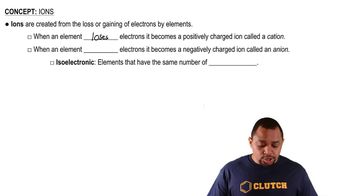
Isoelectronic Ions

Isoelectronic ions are ions that have the same number of electrons, resulting in identical electron configurations. In this case, F- and Na+ both have 10 electrons, making them isoelectronic. This similarity allows for a direct comparison of their properties, such as ionic radius and effective nuclear charge.
Video consigliato:

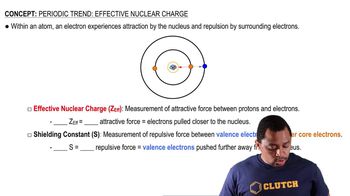
Effective Nuclear Charge (Z_eff)

Effective nuclear charge refers to the net positive charge experienced by an electron in a multi-electron atom. It accounts for the shielding effect of inner electrons that reduce the full nuclear charge. For isoelectronic ions, the effective nuclear charge increases with the atomic number, affecting the attraction between the nucleus and the outer electrons.
Video consigliato:
Percorso guidato
01:51
Effective Nuclear Charge

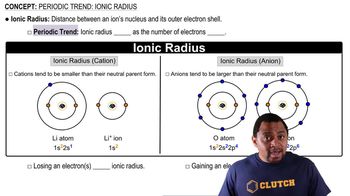
Ionic Radius

Ionic radius is the measure of an ion's size, which can be influenced by its charge and the effective nuclear charge. In isoelectronic ions, the ion with the higher effective nuclear charge will have a smaller ionic radius due to stronger attraction between the nucleus and the electrons. Thus, Na+ will have a smaller radius than F- because Na+ has a higher Z_eff.
Video consigliato: