Ch.7 - Periodic Properties of the Elements
Brown - Chemistry: The Central Science 14th Edition
Brown14th EditionChemistry: The Central ScienceISBN: 9780134414232Non è quello che usi tu?Cambia libro di testo
Capitolo 7, Problema 15e

Detailed calculations show that the value of Zeff for the outermost electrons in Na and K atoms is 2.51+ and 3.49+, respectively. (e) Predict Zeff for the outermost electrons in the Rb atom based on the calculations for Na and K.

Guida verificata passo dopo passo
1
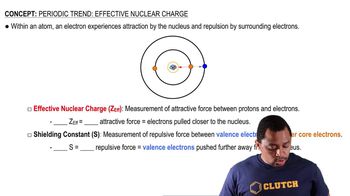
Understand the concept of effective nuclear charge (Z_{eff}): It is the net positive charge experienced by an electron in a multi-electron atom.
Recognize the trend in Z_{eff} across the alkali metals (Na, K, Rb): As you move down a group in the periodic table, the Z_{eff} generally increases due to the addition of more protons in the nucleus.
Note the given Z_{eff} values for Na and K: Na has a Z_{eff} of 2.51+ and K has a Z_{eff} of 3.49+.
Predict the Z_{eff} for Rb: Since Rb is below K in the periodic table, its Z_{eff} should be slightly higher than that of K, following the trend.
Estimate the Z_{eff} for Rb by considering the incremental increase from Na to K and applying a similar increase from K to Rb.

Risposta video verificata per un problema simile:

Questa soluzione video è stata consigliata dai nostri tutor come utile per risolvere questo problema.
Durata del video:
2m

Concetti chiave

Ecco i concetti essenziali che devi comprendere per rispondere correttamente alla domanda.

Effective Nuclear Charge (Zeff)

Effective Nuclear Charge (Zeff) is the net positive charge experienced by an electron in a multi-electron atom. It accounts for the actual nuclear charge (the number of protons) and the shielding effect caused by inner-shell electrons. As the number of protons increases, the Zeff typically increases, leading to stronger attraction between the nucleus and the outermost electrons.
Video consigliato:
Percorso guidato
01:51
Effective Nuclear Charge

Shielding Effect

The shielding effect refers to the phenomenon where inner-shell electrons partially block the attraction between the nucleus and the outermost electrons. This results in a lower effective nuclear charge felt by the outer electrons. The greater the number of inner electrons, the more significant the shielding effect, which influences the Zeff value for outer electrons in larger atoms.
Video consigliato:
Percorso guidato
02:31
Photoelectric Effect

Trends in Zeff Across Periods

Zeff generally increases across a period in the periodic table due to the increase in nuclear charge without a corresponding increase in shielding. However, as you move down a group, the addition of electron shells increases shielding, which can lead to a smaller increase in Zeff. Understanding these trends helps predict Zeff values for elements based on their position in the periodic table.
Video consigliato:
Percorso guidato
00:38
Periodic Trends
Pratica correlata
Domanda del libro di testo
Which will experience the greater effect nuclear charge, the electrons in the n = 2 shell in F or the n = 2 shell in B? Which will be closer to the nucleus?
1455
views

Domanda del libro di testo

Which of the following statements about effective nuclear charge for the outermost valence electron of an atom is incorrect? (i) The effective nuclear charge can be thought of as the true nuclear charge minus a screening constant due to the other electrons in the atom. (ii) Effective nuclear charge increases going left to right across a row of the periodic table. (iii) Valence electrons screen the nuclear charge more effectively than do core electrons. (iv) The effective nuclear charge shows a sudden decrease when we go from the end of one row to the beginning of the next row of the periodic table. (v) The change in effective nuclear charge going down a column of the periodic table is generally less than that going across a row of the periodic table

2661
views
Domanda del libro di testo

Detailed calculations show that the value of Zeff for the outermost electrons in Na and K atoms is 2.51+ and 3.49+, respectively. (b) What values do you estimate for Zeff using Slater’s rules?

Domanda del libro di testo

Detailed calculations show that the value of Zeff for the outermost electrons in Si and Cl atoms is 4.29+ and 6.12+, respectively. (a) What value do you estimate for Zeff experienced by the outermost electron in both Si and Cl by assuming core electrons contribute 1.00 and valence electrons contribute 0.00 to the screening constant?

4097
views
Domanda del libro di testo

Detailed calculations show that the value of Zeff for the outermost electrons in Na and K atoms is 2.51+ and 3.49+, respectively. (a) What value do you estimate for Zeff experienced by the outermost electron in both Na and K by assuming core electrons contribute 1.00 and valence electrons contribute 0.00 to the screening constant?