Ch.7 - Periodic Properties of the Elements
Brown - Chemistry: The Central Science 14th Edition
Brown14th EditionChemistry: The Central ScienceISBN: 9780134414232Non è quello che usi tu?Cambia libro di testo
Capitolo 7, Problema 48

Give examples of transition metal ions with +3 charge that have an electron configuration of nd5 (n = 3, 4, 5...).

Guida verificata passo dopo passo
1
Identify the general electron configuration for transition metals, which is typically written as (n-1)d^(1-10) ns^2.
Understand that the +3 charge indicates the loss of three electrons from the neutral atom. For transition metals, these electrons are usually removed from the s orbital first and then from the d orbital.
Recognize that the electron configuration of nd5 means there are 5 electrons in the d orbital of the nth energy level after the ionization.
Calculate the original electron configuration of the neutral atom before losing electrons. Since three electrons are lost to achieve a +3 charge, the neutral atom would have had 2 additional electrons in the s orbital and 5 in the d orbital, making it (n-1)d^5 ns^2.
Identify transition metals that can have this configuration in their neutral state and then form a +3 ion with an nd5 configuration. Examples include: Manganese (Mn), which in its neutral state has the electron configuration [Ar] 3d^5 4s^2. When it forms Mn^3+, it loses two 4s electrons and one 3d electron, resulting in [Ar] 3d^5. Another example is Chromium (Cr), which in its neutral state has the electron configuration [Ar] 3d^5 4s^1. When it forms Cr^3+, it loses one 4s electron and two 3d electrons, resulting in [Ar] 3d^3.

Risposta video verificata per un problema simile:

Questa soluzione video è stata consigliata dai nostri tutor come utile per risolvere questo problema.
Durata del video:
6m

Concetti chiave

Ecco i concetti essenziali che devi comprendere per rispondere correttamente alla domanda.

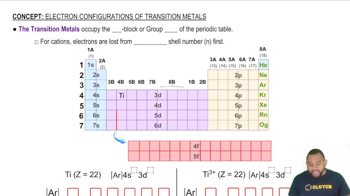
Transition Metals

Transition metals are elements found in the d-block of the periodic table, characterized by their ability to form variable oxidation states and complex ions. They typically have partially filled d-orbitals, which allow them to engage in bonding and exhibit unique properties such as catalytic activity and colored compounds.
Video consigliato:
Percorso guidato
03:12
Transition Metals

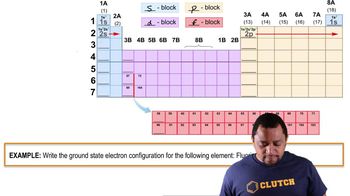
Electron Configuration

Electron configuration describes the distribution of electrons in an atom's orbitals. For transition metals, the electron configuration can be expressed in terms of the principal quantum number (n) and the d-orbital occupancy. A configuration of nd5 indicates that there are five electrons in the d-orbital, which is significant for understanding the chemical behavior and reactivity of these ions.
Video consigliato:
Percorso guidato
01:33
Electron Configuration Example

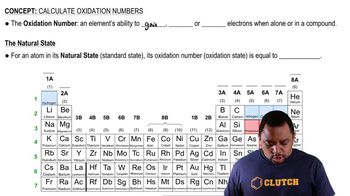
Oxidation States

Oxidation states refer to the charge of an ion, indicating the number of electrons lost or gained by an atom in a compound. For transition metals, the +3 oxidation state is common and results from the loss of three electrons, often from both the s and d orbitals. This state is crucial for identifying specific transition metal ions with an electron configuration of nd5.
Video consigliato:
Percorso guidato
02:42
Oxidation Numbers