
The prefix eka- comes from the Sanskrit word for 'one.' Mendeleev used this prefix to indicate that the unknown element was one place away from the known element that followed the prefix. For example, eka-silicon, which we now call germanium, is one element below silicon. Mendeleev also predicted the existence of eka-manganese, which was not experimentally confirmed until 1937 because this element is radioactive and does not occur in nature. Based on the periodic table shown in Figure 7.1, what do we now call the element Mendeleev called eka-manganese?
Ch.7 - Periodic Properties of the Elements
Brown14th EditionChemistry: The Central ScienceISBN: 9780134414232Non è quello che usi tu?Cambia libro di testo
Capitolo 7, Problema 4
In the following reaction
which sphere represents a metal and which represents a nonmetal?
Guida verificata passo dopo passo1
Identify the spheres in the reaction diagram. Typically, different spheres in a chemical reaction diagram represent different types of atoms.
Determine the characteristics of metals and nonmetals. Metals tend to lose electrons and form positive ions, while nonmetals tend to gain electrons and form negative ions.
Look for clues in the reaction diagram such as charges, positions, or connections that might indicate which sphere is more likely to lose or gain electrons.
Consider the typical physical properties of metals and nonmetals. Metals are usually shiny, malleable, and good conductors of heat and electricity, whereas nonmetals are not.
Based on these observations and the context of the reaction, assign each sphere as either a metal or a nonmetal.

Risposta video verificata per un problema simile:
Questa soluzione video è stata consigliata dai nostri tutor come utile per risolvere questo problema.
Durata del video:
1mConcetti chiave
Ecco i concetti essenziali che devi comprendere per rispondere correttamente alla domanda.
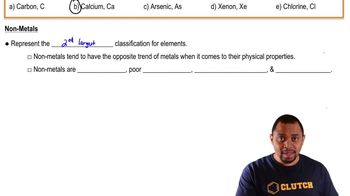
Metals and Nonmetals
Metals are elements that typically exhibit high electrical and thermal conductivity, malleability, and ductility. They are usually found on the left side and in the center of the periodic table. Nonmetals, on the other hand, are elements that lack these metallic properties and are found on the right side of the periodic table. They tend to be poor conductors and can exist in various states at room temperature.
Video consigliato:
Percorso guidato
Nonmetal Properties
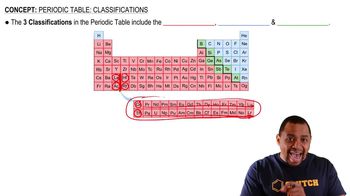
Periodic Table
The periodic table organizes elements based on their atomic number, electron configuration, and recurring chemical properties. Elements are grouped into columns called groups or families, which share similar characteristics. Understanding the layout of the periodic table is essential for identifying metals and nonmetals, as it visually distinguishes these categories based on their properties and reactivity.
Video consigliato:
Percorso guidato
Periodic Table Classifications
Chemical Symbols and Representations
In chemical reactions, elements are often represented by their chemical symbols, which are one or two-letter abbreviations derived from their names. For example, 'Na' represents sodium (a metal), while 'Cl' represents chlorine (a nonmetal). Recognizing these symbols is crucial for interpreting chemical equations and understanding the roles of different elements in reactions.
Video consigliato:
Percorso guidato
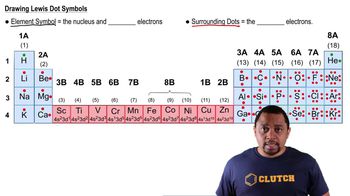
Lewis Dot Symbols
Pratica correlata
Domanda del libro di testo
2375
views
1
rank
Domanda del libro di testo
Which of these spheres represents F, which represents Br, and which represents Br-?
616
views
Domanda del libro di testo
Consider the Mg2+, Cl-, K+, and Se2- ions. The four spheres below represent these four ions, scaled according to ionic size. (b) In terms of size, between which of the spheres would you find the (i) Ca2+ and (ii) S2- ions?
1019
views
Domanda del libro di testo
Shown below is a qualitative diagram of the atomic orbital energies for an Na atom. The number of orbitals in each subshell is not shown.
(d) A sodium vapor lamp (Figure 7.23) operates by using electricity to excite the highest-energy electron to the next highest-energy level. Light is produced when the excited electron drops back to the lower level. Which two energy levels are involved in this process for the Na atom?
575
views
