Ch.7 - Periodic Properties of the Elements
Brown - Chemistry: The Central Science 14th Edition
Brown14th EditionChemistry: The Central ScienceISBN: 9780134414232Non è quello che usi tu?Cambia libro di testo
Capitolo 7, Problema 109a

Moseley established the concept of atomic number by studying X rays emitted by the elements. The X rays emitted by some of the elements have the following wavelengths: Element Wavelength (pm) Ne 1461 Ca 335.8 Zn 143.5 Zr 78.6 Sn 49.1 (a) Calculate the frequency, n, of the X rays emitted by each of the elements, in Hz.

Guida verificata passo dopo passo
1
1. The first step is to convert the wavelength from picometers (pm) to meters (m) since the standard unit of wavelength in the formula for frequency is meters. You can do this by multiplying the given wavelength by 1e-12.
2. Once you have the wavelength in meters, you can calculate the frequency using the formula for the speed of light, c = λν, where c is the speed of light (3.00 x 10^8 m/s), λ is the wavelength, and ν is the frequency. Rearranging the formula to solve for frequency gives ν = c/λ.
3. Substitute the speed of light and the wavelength (in meters) into the formula to calculate the frequency for each element.
4. Repeat these steps for each of the elements to find their respective frequencies.
5. Remember that the frequency will be in Hz (Hertz), which is equivalent to s^-1 (per second).

Risposta video verificata per un problema simile:

Questa soluzione video è stata consigliata dai nostri tutor come utile per risolvere questo problema.
Durata del video:
5m

Concetti chiave

Ecco i concetti essenziali che devi comprendere per rispondere correttamente alla domanda.

Frequency and Wavelength Relationship

The frequency of electromagnetic radiation is inversely related to its wavelength, described by the equation c = λν, where c is the speed of light (approximately 3.00 x 10^8 m/s), λ is the wavelength in meters, and ν is the frequency in hertz (Hz). This relationship is fundamental in calculating the frequency of X-rays from their given wavelengths.
Video consigliato:
Percorso guidato
00:31
Frequency-Wavelength Relationship

Units of Measurement

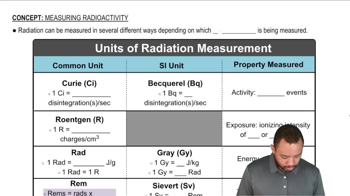
In the context of this question, it is crucial to convert the given wavelengths from picometers (pm) to meters (m) for accurate calculations. Since 1 pm equals 1 x 10^-12 meters, understanding unit conversion is essential for applying the frequency-wavelength relationship correctly.
Video consigliato:
Percorso guidato
02:52
Units of Radiation Measurement

Electromagnetic Spectrum

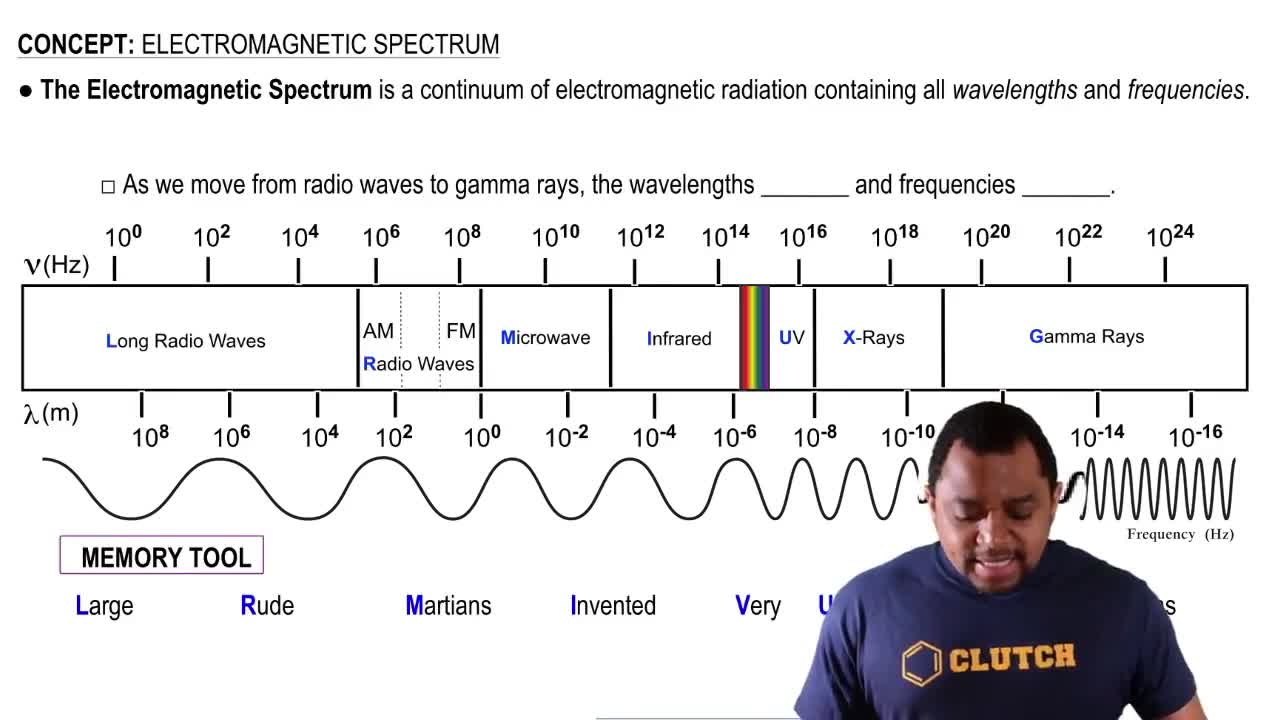
X-rays are a form of electromagnetic radiation, which includes a range of wavelengths and frequencies. Understanding where X-rays fit within the electromagnetic spectrum helps contextualize their properties and applications, including their role in Moseley's work on atomic numbers and the study of atomic structure.
Video consigliato:
Percorso guidato
02:53
Electromagnetic Spectrum
Pratica correlata
Domanda del libro di testo

Moseley established the concept of atomic number by studying X rays emitted by the elements. The X rays emitted by some of the elements have the following wavelengths: Element Wavelength (pm) Ne 1461 Ca 335.8 Zn 143.5 Zr 78.6 Sn 49.1 (d) Use the result from part (b) to predict the X-ray wavelength emitted by iron.

552
views
Domanda del libro di testo

Moseley established the concept of atomic number by studying X rays emitted by the elements. The X rays emitted by some of the elements have the following wavelengths: Element Wavelength (pm) Ne 1461 Ca 335.8 Zn 143.5 Zr 78.6 Sn 49.1 (e) A particular element emits X rays with a wavelength of 98.0 pm. What element do you think it is?

Domanda del libro di testo

We will see in Chapter 12 that semiconductors are materials that conduct electricity better than nonmetals but not as well as metals. The only two elements in the periodic table that are technologically useful semiconductors are silicon and germanium. Integrated circuits in computer chips today are based on silicon. Compound semiconductors are also used in the electronics industry. Examples are gallium arsenide, GaAs; gallium phosphide, GaP; cadmium sulfide, CdS; and cadmium selenide, CdSe. (b) Workers in the semiconductor industry refer to 'II–VI' and 'III–V' materials, using Roman numerals. Can you identify which compound semiconductors are II–VI and which are III–V? (c) Suggest other compositions of compound semiconductors based on the positions of their elements in the periodic table.

297
views
Domanda del libro di testo

We will see in Chapter 12 that semiconductors are materials that conduct electricity better than nonmetals but not as well as metals. The only two elements in the periodic table that are technologically useful semiconductors are silicon and germanium. Integrated circuits in computer chips today are based on silicon. Compound semiconductors are also used in the electronics industry. Examples are gallium arsenide, GaAs; gallium phosphide, GaP; cadmium sulfide, CdS; and cadmium selenide, CdSe. (a) What is the relationship between the compound semiconductors' compositions and the positions of their elements on the periodic table relative to Si and Ge?

286
views
Domanda del libro di testo

Moseley established the concept of atomic number by studying X rays emitted by the elements. The X rays emitted by some of the elements have the following wavelengths: Element Wavelength (pm) Ne 1461 Ca 335.8 Zn 143.5 Zr 78.6 Sn 49.1 (b) Plot the square root of n versus the atomic number of the element. What do you observe about the plot? (e) A particular element emits X rays with a wavelength of 98.0 pm. What element do you think it is?

427
views