Ch.7 - Periodic Properties of the Elements
Brown - Chemistry: The Central Science 14th Edition
Brown14th EditionChemistry: The Central ScienceISBN: 9780134414232Non è quello che usi tu?Cambia libro di testo
Capitolo 7, Problema 39

Which element has the highest second ionization energy: Li, K, or Be?

Guida verificata passo dopo passo
1
Step 1: Understand the concept of ionization energy. Ionization energy is the energy required to remove an electron from an atom or ion. The second ionization energy refers to the energy required to remove a second electron after the first has already been removed.
Step 2: Consider the atomic structure of the elements. Lithium (Li) has 3 electrons, Potassium (K) has 19 electrons, and Beryllium (Be) has 4 electrons. For Li and K, the second ionization energy involves removing an electron from a full shell, which requires a lot of energy. For Be, the second ionization energy involves removing an electron from an incomplete shell, which requires less energy.
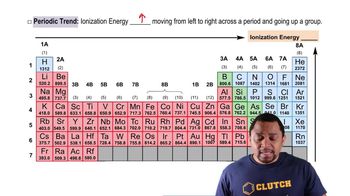
Step 3: Consider the periodic trends. Ionization energy generally increases across a period (from left to right) and decreases down a group (from top to bottom) on the periodic table. Therefore, Be (which is to the right of Li and above K on the periodic table) should have a higher second ionization energy than either Li or K.
Step 4: Consider the electron configuration. The electron configuration of Be is [He]2s^2. After the first ionization, Be^+ has the electron configuration of He, which is a stable noble gas configuration. Removing another electron from this stable configuration requires a lot of energy.
Step 5: Based on these considerations, Be should have the highest second ionization energy among Li, K, and Be.

Risposta video verificata per un problema simile:

Questa soluzione video è stata consigliata dai nostri tutor come utile per risolvere questo problema.
Durata del video:
5m

Concetti chiave

Ecco i concetti essenziali che devi comprendere per rispondere correttamente alla domanda.

Ionization Energy

Ionization energy is the energy required to remove an electron from an atom or ion in its gaseous state. It is a key factor in determining an element's reactivity and is influenced by the atomic structure, including the number of protons and the distance of electrons from the nucleus.
Video consigliato:
Percorso guidato
01:19
Ionization Energy

Second Ionization Energy

Second ionization energy refers to the energy needed to remove a second electron from a singly charged cation. This value is typically higher than the first ionization energy due to increased effective nuclear charge acting on the remaining electrons, making them harder to remove.
Video consigliato:
Percorso guidato
01:19
Ionization Energy

Trends in Ionization Energy

Ionization energy generally increases across a period from left to right and decreases down a group in the periodic table. This trend is due to the increasing nuclear charge and decreasing atomic radius across a period, while increased electron shielding and distance from the nucleus down a group reduce ionization energy.
Video consigliato:
Percorso guidato
01:08
Ionization Energy Trends