Ch.7 - Periodic Properties of the Elements
Brown - Chemistry: The Central Science 14th Edition
Brown14th EditionChemistry: The Central ScienceISBN: 9780134414232Non è quello che usi tu?Cambia libro di testo
Capitolo 7, Problema 97

Which of the following chemical equations is connected to the definitions of (a) the first ionization energy of oxygen (i) O1g2 + e-¡O-1g2 (ii) O1g2¡O+1g2 + e- (iii) O1g2 + 2 e-¡O2-1g2 (iv) O1g2¡O2+1g2 + 2 e- (v) O+1g2¡O2+1g2 + e-

Guida verificata passo dopo passo
1
insert step 1> Identify the definition of first ionization energy: it is the energy required to remove the outermost electron from a neutral atom in the gaseous state.
insert step 2> Look for the equation that represents the removal of one electron from a neutral oxygen atom (O) in the gaseous state.
insert step 3> Analyze each option: (i) represents the gain of an electron, (ii) represents the removal of one electron from a neutral oxygen atom, (iii) represents the gain of two electrons, (iv) represents the removal of two electrons, and (v) represents the removal of an electron from a positively charged ion.
insert step 4> Determine that option (ii) O(g) → O⁺(g) + e⁻ correctly represents the first ionization energy of oxygen.
insert step 5> Conclude that the correct chemical equation related to the first ionization energy of oxygen is option (ii).

Risposta video verificata per un problema simile:

Questa soluzione video è stata consigliata dai nostri tutor come utile per risolvere questo problema.
Durata del video:
2m

Concetti chiave

Ecco i concetti essenziali che devi comprendere per rispondere correttamente alla domanda.

Ionization Energy

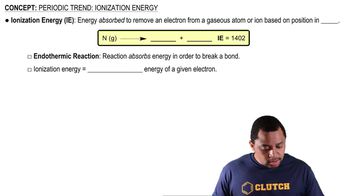
Ionization energy is the energy required to remove an electron from an atom or ion in its gaseous state. The first ionization energy specifically refers to the energy needed to remove the outermost electron from a neutral atom, resulting in a positively charged ion. Understanding this concept is crucial for analyzing chemical equations that involve electron removal.
Video consigliato:
Percorso guidato
01:19
Ionization Energy

Oxygen's Electron Configuration

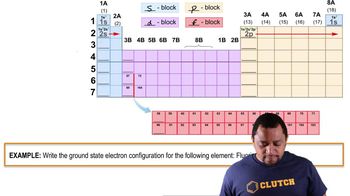
Oxygen has an atomic number of 8, with an electron configuration of 1s² 2s² 2p⁴. This configuration indicates that oxygen has six valence electrons, making it relatively electronegative and likely to gain or lose electrons during chemical reactions. Recognizing the electron configuration helps in predicting the behavior of oxygen in ionization processes.
Video consigliato:
Percorso guidato
01:33
Electron Configuration Example

Chemical Equations and Electron Transfer

Chemical equations represent the transformation of reactants into products, often involving the transfer of electrons. In the context of ionization, the equations illustrate how an atom loses electrons to form cations. Understanding how to interpret these equations is essential for identifying which equation corresponds to the first ionization energy of oxygen.
Video consigliato:
Percorso guidato
01:32
Balancing Chemical Equations