It is possible to define metallic character as we do in this book and base it on the reactivity of the element and the ease with which it loses electrons. Alternatively, one could measure how well electricity is conducted by each of the elements to determine how 'metallic' the elements are. On the basis of conductivity, there is not much of a trend in the periodic table: Silver is the most conductive metal, and manganese the least. Look up the first ionization energies of silver and manganese; which of these two elements would you call more metallic based on the way we define it in this book?
Ch.7 - Periodic Properties of the Elements
Brown14th EditionChemistry: The Central ScienceISBN: 9780134414232Non è quello che usi tu?Cambia libro di testo
Capitolo 7, Problema 102
Which of the following is the expected product of the reaction of K(s) and H2(g)? (i) KH(s), (ii) K2H(s), (iii) KH2(s), (iv) K2H2(s), or (v) K(s) and H2(g) will not react with one another.
Guida verificata passo dopo passo1
Identify the reactants: Potassium (K) is a metal and Hydrogen (H2) is a diatomic non-metal gas.
Consider the reactivity of potassium: Potassium is an alkali metal, which are known to react with hydrogen to form metal hydrides.
Write the balanced chemical equation for the reaction: Potassium reacts with hydrogen gas to form potassium hydride (KH). The balanced equation is 2K(s) + H2(g) -> 2KH(s).
Analyze the possible products: From the balanced equation, the expected product is potassium hydride (KH), which corresponds to option (i).
Conclude that the other options (ii, iii, iv, v) do not represent the expected product based on the chemical properties and typical reactions of potassium with hydrogen.

Risposta video verificata per un problema simile:
Questa soluzione video è stata consigliata dai nostri tutor come utile per risolvere questo problema.
Durata del video:
2mConcetti chiave
Ecco i concetti essenziali che devi comprendere per rispondere correttamente alla domanda.
Reactivity of Alkali Metals
Alkali metals, such as potassium (K), are highly reactive, especially with nonmetals like hydrogen (H). When alkali metals react with hydrogen gas, they typically form metal hydrides. This reactivity is due to their low ionization energy, which allows them to easily lose their outermost electron and form positive ions.
Video consigliato:
Percorso guidato
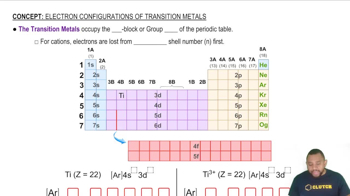
Transition Metals
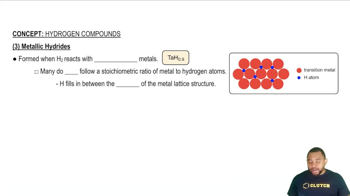
Formation of Metal Hydrides
Metal hydrides are compounds formed when metals react with hydrogen. In the case of potassium, the expected product is potassium hydride (KH). This compound consists of potassium ions (K+) and hydride ions (H-), showcasing the typical stoichiometry of one metal atom reacting with one hydrogen molecule.
Video consigliato:
Percorso guidato
Metallic Hydrides
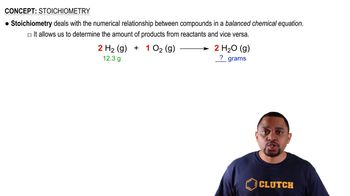
Stoichiometry of Chemical Reactions
Stoichiometry involves the calculation of reactants and products in chemical reactions based on the conservation of mass. In the reaction between potassium and hydrogen, the balanced equation indicates that two potassium atoms react with one hydrogen molecule to produce two units of potassium hydride (2K + H2 → 2KH). Understanding stoichiometry is essential for predicting the correct products of a reaction.
Video consigliato:
Percorso guidato
Stoichiometry Concept
Pratica correlata
Domanda del libro di testo
523
views
Domanda del libro di testo
The first ionization energy of the oxygen molecule is the energy required for the following process: O21g2¡O2 +1g2 + e- The energy needed for this process is 1175 kJ>mol, very similar to the first ionization energy of Xe. Would you expect O2 to react with F2? If so, suggest a product or products of this reaction.
3944
views
Domanda del libro di testo
Hydrogen is an unusual element because it behaves in some ways like the alkali metal elements and in other ways like nonmetals. Its properties can be explained in part by its electron configuration and by the values for its ionization energy and electron affinity. (a) Explain why the electron affinity of hydrogen is much closer to the values for the alkali elements than for the halogens.
1349
views
