
Ch.7 - Periodic Properties of the Elements
Brown - Chemistry: The Central Science 14th Edition
Brown14th EditionChemistry: The Central ScienceISBN: 9780134414232Non è quello che usi tu?Cambia libro di testo
Capitolo 7, Problema 66

Write balanced equations for the following reactions: (a) sulfur dioxide with water (b) lithium oxide in water (c) zinc oxide with dilute hydrochloric acid (d) arsenic trioxide with aqueous potassium hydroxide.

Guida verificata passo dopo passo
1
Identify the reactants: Arsenic trioxide (As2O3) and potassium hydroxide (KOH).
Determine the products: When arsenic trioxide reacts with a strong base like potassium hydroxide, it forms potassium arsenite (K3AsO3) and water (H2O).
Write the unbalanced chemical equation: As2O3 + KOH ightarrow K3AsO3 + H2O.
Balance the equation by adjusting the coefficients to ensure the number of atoms for each element is equal on both sides of the equation. Start by balancing the arsenic (As) and oxygen (O) atoms, then adjust the potassium (K) and hydrogen (H) atoms.
Check the final balanced equation to ensure mass and charge are balanced.

Risposta video verificata per un problema simile:

Questa soluzione video è stata consigliata dai nostri tutor come utile per risolvere questo problema.
Durata del video:
4m

Concetti chiave

Ecco i concetti essenziali che devi comprendere per rispondere correttamente alla domanda.

Balancing Chemical Equations

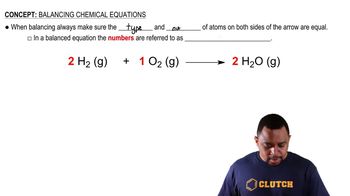
Balancing chemical equations involves ensuring that the number of atoms for each element is the same on both the reactant and product sides. This is based on the law of conservation of mass, which states that matter cannot be created or destroyed in a chemical reaction. To balance an equation, coefficients are adjusted in front of the chemical formulas, rather than changing the formulas themselves.
Video consigliato:
Percorso guidato
01:32
Balancing Chemical Equations

Acid-Base Reactions

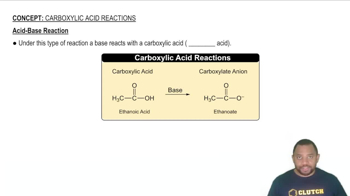
Acid-base reactions typically involve the transfer of protons (H⁺ ions) between reactants. In this case, arsenic trioxide (As₂O₃) can react with potassium hydroxide (KOH), which is a strong base, to form a salt and water. Understanding the nature of the reactants and the products formed is crucial for predicting the outcome of the reaction.
Video consigliato:
Percorso guidato
01:09
Acid-Base Reaction

Solubility and Aqueous Solutions

In aqueous solutions, the solubility of compounds plays a significant role in determining the products of a reaction. Potassium hydroxide is soluble in water, dissociating into K⁺ and OH⁻ ions. Knowing the solubility of arsenic compounds helps predict whether a precipitate will form or if the reaction will proceed in solution, which is essential for writing the balanced equation.
Video consigliato:
Percorso guidato
01:11
Types of Aqueous Solutions