
Ch.8 - Basic Concepts of Chemical Bonding
Brown - Chemistry: The Central Science 14th Edition
Brown14th EditionChemistry: The Central ScienceISBN: 9780134414232Non è quello che usi tu?Cambia libro di testo
Capitolo 8, Problema 24a

(a) Does the lattice energy of an ionic solid increase or decrease (i) as the charges of the ions increase, (ii) as the sizes of the ions increase?

Guida verificata passo dopo passo
1
Understand that lattice energy is the energy required to separate one mole of an ionic solid into its gaseous ions.
Recall that lattice energy is directly proportional to the product of the charges of the ions. Therefore, as the charges of the ions increase, the lattice energy increases.
Remember that lattice energy is inversely proportional to the distance between the ions, which is related to the size of the ions. As the sizes of the ions increase, the distance between them increases, leading to a decrease in lattice energy.
Consider the formula for lattice energy: \( U = \frac{k \cdot Q_1 \cdot Q_2}{r} \), where \( U \) is the lattice energy, \( k \) is a constant, \( Q_1 \) and \( Q_2 \) are the charges of the ions, and \( r \) is the distance between the centers of the ions.
Summarize: (i) Lattice energy increases with increasing ion charges, and (ii) lattice energy decreases with increasing ion sizes.

Risposta video verificata per un problema simile:

Questa soluzione video è stata consigliata dai nostri tutor come utile per risolvere questo problema.
Durata del video:
1m

Concetti chiave

Ecco i concetti essenziali che devi comprendere per rispondere correttamente alla domanda.

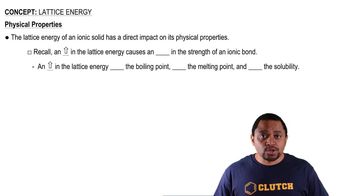
Lattice Energy

Lattice energy is the energy released when gaseous ions combine to form an ionic solid. It is a measure of the strength of the forces between the ions in an ionic compound. Higher lattice energy indicates a more stable ionic solid, as it reflects stronger ionic bonds resulting from the electrostatic attraction between oppositely charged ions.
Video consigliato:

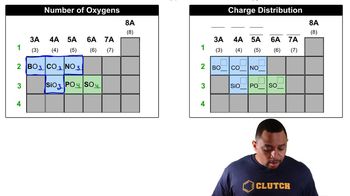
Charge of Ions

The charge of ions significantly affects lattice energy. As the charges of the ions increase, the electrostatic attraction between them becomes stronger, leading to a higher lattice energy. For example, a compound formed from divalent ions (e.g., Mg²⁺ and O²⁻) will have a greater lattice energy than one formed from monovalent ions (e.g., Na⁺ and Cl⁻) due to the increased charge.
Video consigliato:
Percorso guidato
01:39
Polyatomic Ion Charges

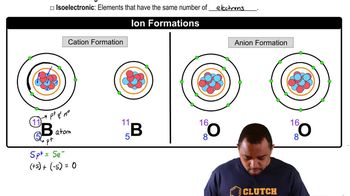
Size of Ions

The size of the ions also influences lattice energy. As the size of the ions increases, the distance between the centers of the ions increases, which weakens the electrostatic attraction and results in lower lattice energy. Therefore, larger ions lead to a decrease in lattice energy, as seen when comparing NaCl to KCl, where K⁺ is larger than Na⁺.
Video consigliato: