
Ch.8 - Basic Concepts of Chemical Bonding
Brown - Chemistry: The Central Science 14th Edition
Brown14th EditionChemistry: The Central ScienceISBN: 9780134414232Non è quello che usi tu?Cambia libro di testo
Capitolo 8, Problema 22a

NaCl and KF have the same crystal structure. The only difference between the two is the distance that separates cations and anions. (a) The lattice energies of NaCl and KF are given in Table 8.1. Based on the lattice energies, would you expect the Na─Cl or the K─F distance to be longer?

Guida verificata passo dopo passo
1
Identify the relationship between lattice energy and ionic distance. Lattice energy is inversely proportional to the distance between ions; the greater the distance, the lower the lattice energy.
Look up the lattice energies for NaCl and KF in Table 8.1. Compare the values to determine which compound has the higher lattice energy.
Based on the comparison, determine which compound has the shorter ionic distance. The compound with the higher lattice energy will have the shorter distance between ions.
Conclude which ionic distance is longer based on the inverse relationship between lattice energy and ionic distance. If NaCl has a higher lattice energy than KF, then the Na─Cl distance is shorter, making the K─F distance longer, and vice versa.
Summarize the findings: The compound with the lower lattice energy will have the longer distance between its cations and anions.

Risposta video verificata per un problema simile:

Questa soluzione video è stata consigliata dai nostri tutor come utile per risolvere questo problema.
Durata del video:
2m

Concetti chiave

Ecco i concetti essenziali che devi comprendere per rispondere correttamente alla domanda.

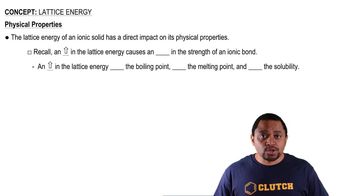
Lattice Energy

Lattice energy is the amount of energy released when gaseous ions combine to form an ionic solid. It is a measure of the strength of the forces between the ions in an ionic compound. Higher lattice energy indicates stronger ionic bonds, which typically results in shorter distances between cations and anions.
Video consigliato:

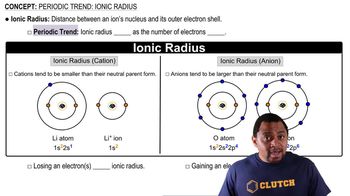
Ionic Radius

Ionic radius refers to the size of an ion in a crystal lattice. Cations are smaller than their parent atoms due to the loss of electrons, while anions are larger due to the gain of electrons. The size of the ions affects the distance between them in the lattice structure, influencing the overall lattice energy.
Video consigliato:

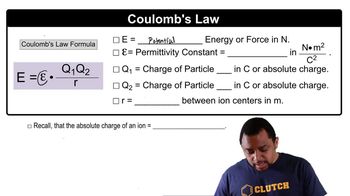
Coulomb's Law

Coulomb's Law describes the electrostatic interaction between charged particles. It states that the force between two charged ions is directly proportional to the product of their charges and inversely proportional to the square of the distance between them. This principle helps explain how the distance between ions affects lattice energy and stability.
Video consigliato:
Percorso guidato
01:15
Coulomb's Law Concept 2