
Ch.8 - Basic Concepts of Chemical Bonding
Brown - Chemistry: The Central Science 14th Edition
Brown14th EditionChemistry: The Central ScienceISBN: 9780134414232Non è quello che usi tu?Cambia libro di testo
Capitolo 8, Problema 102d

One scale for electronegativity is based on the concept that the electronegativity of any atom is proportional to the ionization energy of the atom minus its electron affinity: electronegativity = k1I - EA2, where k is a proportionality constant. (d) Use your result from part (c) to determine the electronegativities of Cl and O using this scale. Use your result to determine the electronegativity of Cl using this scale.

Guida verificata passo dopo passo
1
Step 1: The first step is to understand the formula given. The electronegativity of an atom is given by the formula: electronegativity = k(I - EA), where I is the ionization energy, EA is the electron affinity, and k is a proportionality constant.
Step 2: To find the electronegativity of Chlorine (Cl) and Oxygen (O), you need to know their ionization energies and electron affinities. These values can be found in a standard chemistry reference book or online.
Step 3: Once you have the ionization energy and electron affinity for each atom, substitute these values into the formula. Remember to use the same units for both values.
Step 4: The proportionality constant, k, is the same for all atoms. Therefore, you can compare the electronegativities of different atoms even if you don't know the exact value of k.
Step 5: After substituting the values into the formula, you will get the electronegativity of each atom. The atom with the higher electronegativity is more likely to attract electrons.

Risposta video verificata per un problema simile:

Questa soluzione video è stata consigliata dai nostri tutor come utile per risolvere questo problema.
Durata del video:
4m

Concetti chiave

Ecco i concetti essenziali che devi comprendere per rispondere correttamente alla domanda.

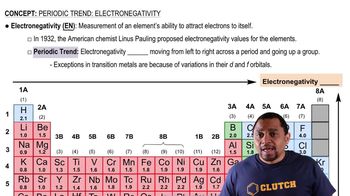
Electronegativity

Electronegativity is a measure of an atom's ability to attract and hold onto electrons when forming chemical bonds. It is a key factor in determining the nature of bonds between atoms, influencing molecular polarity and reactivity. The scale of electronegativity helps predict how electrons are distributed in a molecule, affecting its chemical properties.
Video consigliato:
Percorso guidato
02:10
Electronegativity Trends

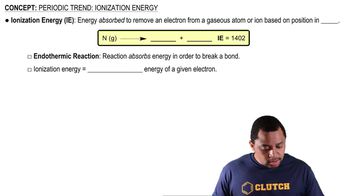
Ionization Energy

Ionization energy is the energy required to remove an electron from an isolated atom in its gaseous state. It reflects how strongly an atom holds onto its electrons; higher ionization energy indicates a stronger attraction. This property is crucial for understanding electronegativity, as atoms with higher ionization energies tend to have higher electronegativities.
Video consigliato:
Percorso guidato
01:19
Ionization Energy

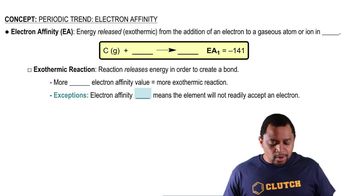
Electron Affinity

Electron affinity is the amount of energy released when an electron is added to a neutral atom in the gas phase. It indicates how much an atom wants to gain an electron. A higher electron affinity means that an atom is more likely to attract additional electrons, which plays a significant role in determining its electronegativity.
Video consigliato:
Percorso guidato
01:34
Electron Affinity