Ch.8 - Basic Concepts of Chemical Bonding
Brown - Chemistry: The Central Science 14th Edition
Brown14th EditionChemistry: The Central ScienceISBN: 9780134414232Non è quello che usi tu?Cambia libro di testo
Capitolo 8, Problema 17b,c

Predict the chemical formula of the ionic compound formed between the following pairs of elements: (b) Mg and O (c) Zn and Cl

Guida verificata passo dopo passo
1
Step 1: Identify the charges of the ions. Magnesium (Mg) is in group 2 of the periodic table and forms a +2 ion. Oxygen (O) is in group 16 and forms a -2 ion.
Step 2: Write the ions side by side, with the cation (positive ion) first. This gives us Mg^2+ and O^2-.
Step 3: The charges on the ions must balance, meaning the total positive charge must equal the total negative charge. In this case, the charges already balance, so we don't need to add any subscripts.
Step 4: Write the formula using the symbols of the ions. The cation is always written first. This gives us MgO.
Step 5: Check your work. The charges should balance to zero. In this case, the +2 charge on the Mg ion balances with the -2 charge on the O ion, so our formula is correct.

Risposta video verificata per un problema simile:

Questa soluzione video è stata consigliata dai nostri tutor come utile per risolvere questo problema.
Durata del video:
54s

Concetti chiave

Ecco i concetti essenziali che devi comprendere per rispondere correttamente alla domanda.

Ionic Bonding

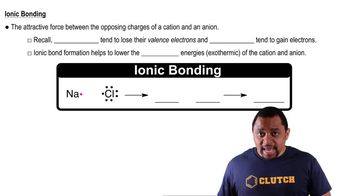
Ionic bonding occurs when atoms transfer electrons to achieve full outer electron shells, resulting in the formation of charged ions. Metals, like magnesium (Mg), tend to lose electrons and form cations, while nonmetals, like oxygen (O), gain electrons to form anions. The electrostatic attraction between these oppositely charged ions leads to the formation of ionic compounds.
Video consigliato:

Charge of Ions

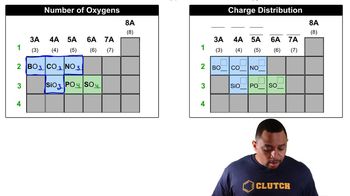
The charge of ions is determined by the number of electrons lost or gained by an atom. Magnesium typically loses two electrons to form a Mg²⁺ ion, while oxygen gains two electrons to form an O²⁻ ion. Understanding the charges of the ions involved is crucial for predicting the correct ratio of ions in the resulting ionic compound.
Video consigliato:
Percorso guidato
01:39
Polyatomic Ion Charges

Empirical Formula

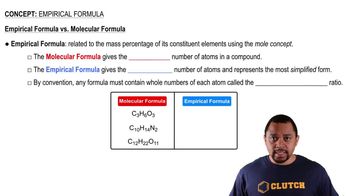
The empirical formula of an ionic compound represents the simplest whole-number ratio of the ions present. For magnesium and oxygen, the Mg²⁺ and O²⁻ ions combine in a 1:1 ratio to form the compound magnesium oxide (MgO). This formula reflects the balance of charges, ensuring that the overall compound is electrically neutral.
Video consigliato:
Percorso guidato
02:26
Empirical vs Molecular Formula