
Ch.8 - Basic Concepts of Chemical Bonding
Brown - Chemistry: The Central Science 14th Edition
Brown14th EditionChemistry: The Central ScienceISBN: 9780134414232Non è quello che usi tu?Cambia libro di testo
Capitolo 8, Problema 123

Use average bond enthalpies from Table 8.4 to estimate the enthalpies of the following gas-phase reactions: Reaction 1: HF1g2 + H2O1g2 Δ F-1g2 + H3O+1g2 Reaction 2: HCl1g2 + H2O1g2 Δ Cl-1g2 + H3O+1g2 Are both reactions exothermic? How do these values relate to the different strengths of hydrofluoric and hydrochloric acid?

Guida verificata passo dopo passo
1
Step 1: Identify the bonds that are broken and formed in each reaction. In Reaction 1, the bonds broken are H-F and H-O, and the bonds formed are F- and H3O+. In Reaction 2, the bonds broken are H-Cl and H-O, and the bonds formed are Cl- and H3O+.
Step 2: Look up the average bond enthalpies for each of these bonds in Table 8.4. Remember that bond breaking is an endothermic process (requires energy) and bond formation is an exothermic process (releases energy).
Step 3: Calculate the total energy change for each reaction by subtracting the energy required to break the bonds from the energy released when new bonds are formed. This will give you the enthalpy change for each reaction.
Step 4: Determine whether each reaction is exothermic or endothermic. If the enthalpy change is negative, the reaction is exothermic (releases heat). If the enthalpy change is positive, the reaction is endothermic (absorbs heat).
Step 5: Compare the enthalpy changes for the two reactions to determine how they relate to the different strengths of hydrofluoric and hydrochloric acid. The reaction with the more negative enthalpy change is the stronger acid, because it releases more heat when it reacts with water.

Risposta video verificata per un problema simile:

Questa soluzione video è stata consigliata dai nostri tutor come utile per risolvere questo problema.
Durata del video:
9m

Concetti chiave

Ecco i concetti essenziali che devi comprendere per rispondere correttamente alla domanda.

Bond Enthalpy

Bond enthalpy, or bond dissociation energy, is the energy required to break a bond in a molecule in the gas phase. It is a measure of bond strength; stronger bonds have higher bond enthalpies. In chemical reactions, the difference in bond enthalpies of reactants and products can be used to estimate the overall enthalpy change of the reaction, indicating whether it is exothermic or endothermic.
Video consigliato:
Percorso guidato
02:34
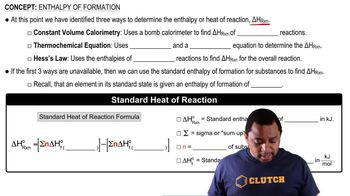
Enthalpy of Formation

Enthalpy Change (ΔH)

Enthalpy change (ΔH) is the heat content change of a system at constant pressure during a chemical reaction. A negative ΔH indicates that the reaction releases heat to the surroundings, classifying it as exothermic, while a positive ΔH indicates heat absorption, classifying it as endothermic. Estimating ΔH using average bond enthalpies allows chemists to predict the energy dynamics of reactions.
Video consigliato:
Percorso guidato
02:34
Enthalpy of Formation

Acid Strength and Ionization

The strength of an acid is determined by its ability to donate protons (H+) in solution, which is influenced by the stability of the resulting ions. Hydrofluoric acid (HF) is a weak acid, while hydrochloric acid (HCl) is a strong acid. The differences in acid strength can be related to the bond strength of the H-X bond (where X is the halogen), with weaker bonds leading to stronger acids due to easier ionization.
Video consigliato:
Percorso guidato
03:51
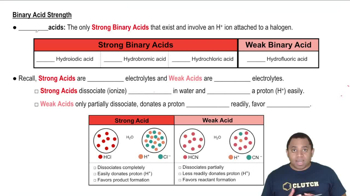
Binary Acid Strengths