Ch.8 - Basic Concepts of Chemical Bonding
Brown - Chemistry: The Central Science 14th Edition
Brown14th EditionChemistry: The Central ScienceISBN: 9780134414232Non è quello che usi tu?Cambia libro di testo
Capitolo 8, Problema 14a,b

What is the Lewis symbol for each of the following atoms or ions? (a) Be (b) Rb

Guida verificata passo dopo passo
1
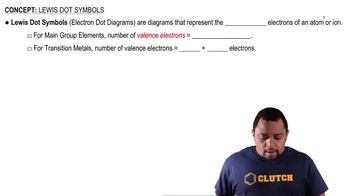
Understand the concept of Lewis symbols: Lewis symbols represent the valence electrons of an atom or ion using dots around the chemical symbol. Each dot represents one valence electron.
Determine the number of valence electrons for each atom or ion: (a) Beryllium (Be) is in Group 2 of the periodic table, so it has 2 valence electrons. (b) Rubidium (Rb) is in Group 1, so it has 1 valence electron.
Draw the Lewis symbol for Beryllium (Be): Place the chemical symbol 'Be' and surround it with two dots representing its two valence electrons. The dots are typically placed on opposite sides of the symbol.
Draw the Lewis symbol for Rubidium (Rb): Place the chemical symbol 'Rb' and surround it with one dot representing its single valence electron.
Consider ions if applicable: If the problem involves ions, adjust the number of valence electrons accordingly. For example, if Be were to form a Be²⁺ ion, it would lose its two valence electrons, resulting in no dots around the symbol.

Risposta video verificata per un problema simile:

Questa soluzione video è stata consigliata dai nostri tutor come utile per risolvere questo problema.
Durata del video:
26s

Concetti chiave

Ecco i concetti essenziali che devi comprendere per rispondere correttamente alla domanda.

Lewis Symbols

Lewis symbols are a way to represent the valence electrons of an atom or ion using dots around the element's symbol. Each dot corresponds to a valence electron, which are the electrons involved in chemical bonding. This representation helps visualize how atoms interact and form bonds with one another.
Video consigliato:
Percorso guidato
00:52
Lewis Dot Symbols

Valence Electrons

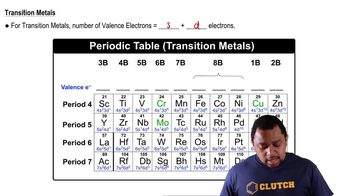
Valence electrons are the outermost electrons of an atom and are crucial in determining how an atom will bond with others. The number of valence electrons varies by element and can be found by looking at the group number in the periodic table. For example, beryllium (Be) has two valence electrons, while rubidium (Rb) has one.
Video consigliato:
Percorso guidato
02:12
Transition Metals Valence Electrons

Ionic vs. Neutral Atoms

Ionic atoms have gained or lost electrons, resulting in a net charge, while neutral atoms have an equal number of protons and electrons. For instance, when beryllium forms a cation (Be²⁺), it loses its two valence electrons, whereas rubidium (Rb) typically forms a cation (Rb⁺) by losing one valence electron. This distinction is important when drawing their Lewis symbols.
Video consigliato:
Percorso guidato
04:13
Crystalline vs Amorphous Solids