Ch.9 - Molecular Geometry and Bonding Theories
Brown - Chemistry: The Central Science 14th Edition
Brown14th EditionChemistry: The Central ScienceISBN: 9780134414232Non è quello che usi tu?Cambia libro di testo
Capitolo 9, Problema 33a

(a) Explain why BrF4- is square planar, whereas BF4- is tetrahedral.

Guida verificata passo dopo passo
1
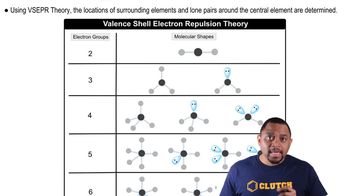
1. The shape of a molecule is determined by the number of electron pairs in the molecule's central atom. This includes both bonding and non-bonding electron pairs. The electron pairs will arrange themselves to minimize repulsion, which is described by the VSEPR (Valence Shell Electron Pair Repulsion) theory.
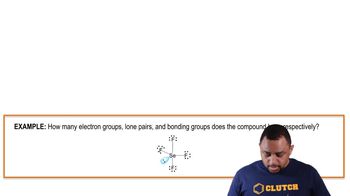
2. For BrF4-, the central atom is Br (Bromine). Bromine has 7 valence electrons. In BrF4-, Bromine forms 4 bonds with Fluorine atoms and has one lone pair of electrons. So, there are 5 regions of electron density around the Bromine atom (4 bonding pairs and 1 lone pair). According to the VSEPR theory, this arrangement leads to a square planar geometry.
3. For BF4-, the central atom is B (Boron). Boron has 3 valence electrons. In BF4-, Boron forms 4 bonds with Fluorine atoms and has no lone pairs of electrons. So, there are 4 regions of electron density around the Boron atom (4 bonding pairs). According to the VSEPR theory, this arrangement leads to a tetrahedral geometry.
4. The difference in the molecular geometries of BrF4- and BF4- is due to the presence of a lone pair of electrons in BrF4- and the absence of a lone pair in BF4-. Lone pairs of electrons occupy more space than bonding pairs and tend to push the bonding pairs closer together, which changes the shape of the molecule.
5. In summary, the shape of a molecule is determined by the number of electron pairs (both bonding and non-bonding) around the central atom. The electron pairs arrange themselves to minimize repulsion, leading to different molecular geometries.

Risposta video verificata per un problema simile:

Questa soluzione video è stata consigliata dai nostri tutor come utile per risolvere questo problema.
Durata del video:
2m

Concetti chiave

Ecco i concetti essenziali che devi comprendere per rispondere correttamente alla domanda.

VSEPR Theory

Valence Shell Electron Pair Repulsion (VSEPR) Theory is a model used to predict the geometry of molecular structures based on the repulsion between electron pairs around a central atom. According to this theory, electron pairs will arrange themselves to minimize repulsion, leading to specific shapes depending on the number of bonding and lone pairs.
Video consigliato:
Percorso guidato
02:13
Molecular Shapes and VSEPR

Lone Pairs vs. Bonding Pairs

In molecular geometry, lone pairs of electrons occupy more space than bonding pairs because they are localized on a single atom. This difference in spatial requirements affects the overall shape of the molecule. For BrF4-, the presence of two lone pairs leads to a square planar arrangement, while BF4- has no lone pairs, resulting in a tetrahedral shape.
Video consigliato:
Percorso guidato
00:51
Electron Groups, Lone Pairs, and Bonding Groups Example

Hybridization

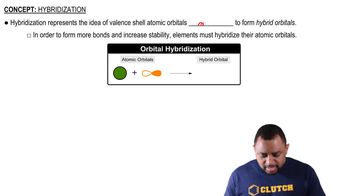
Hybridization is the concept of mixing atomic orbitals to form new hybrid orbitals that can accommodate bonding pairs of electrons. In BF4-, the boron atom undergoes sp3 hybridization, leading to a tetrahedral geometry. In contrast, BrF4- involves dsp2 hybridization due to the presence of lone pairs, resulting in a square planar structure.
Video consigliato: