

Ch.9 - Molecular Geometry and Bonding Theories
Brown - Chemistry: The Central Science 14th Edition
Brown14th EditionChemistry: The Central ScienceISBN: 9780134414232Non è quello che usi tu?Cambia libro di testo
Capitolo 9, Problema 117

(b) Make a similar comparison of nitrogen–nitrogen bonds. What do you observe? (d) Propose a reason for the large difference in your observations of parts (a) and (b).

Guida verificata passo dopo passo
1
Step 1: Identify the types of nitrogen-nitrogen bonds that can exist, such as single (N-N), double (N=N), and triple (N≡N) bonds.
Step 2: Compare the bond lengths and bond strengths of these nitrogen-nitrogen bonds. Generally, as the number of shared electron pairs increases, the bond length decreases and the bond strength increases.
Step 3: Consider the molecular structures where these bonds are found. For example, a single bond is found in hydrazine (N2H4), a double bond in azomethane (N2H2), and a triple bond in nitrogen gas (N2).
Step 4: Analyze the differences in bond energies and lengths between nitrogen-nitrogen bonds and other types of bonds, such as carbon-carbon bonds, to understand the unique properties of nitrogen bonds.
Step 5: Propose a reason for the observed differences, considering factors such as atomic size, electronegativity, and the ability of nitrogen to form multiple bonds due to its electron configuration.

Concetti chiave

Ecco i concetti essenziali che devi comprendere per rispondere correttamente alla domanda.

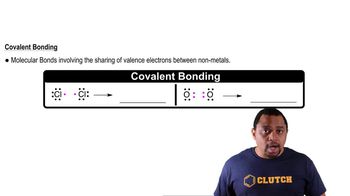
Covalent Bonding

Covalent bonding occurs when two atoms share one or more pairs of electrons, resulting in a stable balance of attractive and repulsive forces between atoms. In nitrogen molecules (N2), a triple bond forms, consisting of one sigma bond and two pi bonds, which significantly strengthens the bond due to the sharing of three pairs of electrons.
Video consigliato:

Bond Strength and Length

Bond strength refers to the energy required to break a bond, while bond length is the distance between the nuclei of two bonded atoms. Generally, shorter bonds are stronger due to the increased overlap of atomic orbitals. In comparing nitrogen-nitrogen bonds, the presence of a triple bond results in a shorter and stronger bond compared to single or double bonds.
Video consigliato:
Percorso guidato
00:36
Average Bond Order

Comparative Analysis

Comparative analysis in chemistry involves evaluating the properties of different chemical bonds or molecules to draw conclusions about their behavior and characteristics. In this context, comparing nitrogen-nitrogen bonds with other types of bonds allows for insights into the factors influencing bond strength, stability, and reactivity, leading to a deeper understanding of molecular interactions.
Video consigliato:
Percorso guidato
06:11
Dimensional Analysis
Pratica correlata
Domanda del libro di testo

Sulfur tetrafluoride (SF4) reacts slowly with O2 to form sulfur tetrafluoride monoxide (OSF4) according to the following unbalanced reaction: SF4(g) + O2(g) → OSF4(g) The O atom and the four F atoms in OSF4 are bonded to a central S atom. (c) Use average bond enthalpies (Table 8.3) to estimate the enthalpy of the reaction. Is it endothermic or exothermic?

688
views
Domanda del libro di testo
Many compounds of the transition-metal elements contain direct bonds between metal atoms. We will assume that the z-axis is defined as the metal–metal bond axis. (d) Sketch the energylevel diagram for the Sc2 molecule, assuming that only the 3d orbital from part (a) is important.
353
views
Domanda del libro di testo
The organic molecules shown here are derivatives of benzene in which six-membered rings are 'fused' at the edges of the hexagons.

(e) Benzene, naphthalene, and anthracene are colorless, but tetracene is orange. What does this imply about the relative HOMO–LUMO energy gaps in these molecules? See the 'Chemistry Put to Work' box on orbitals and energy.
644
views
Domanda del libro di testo
The phosphorus trihalides 1PX32 show the following variation in the bond angle X¬P¬X: PF3, 96.3°; PCl3, 100.3°; PBr3, 101.0°; PI3, 102.0°. The trend is generally attributed to the change in the electronegativity of the halogen. (b) What is the general trend in the X¬P¬X angle as the halide electronegativity increases?
1454
views
Domanda del libro di testo

Sulfur tetrafluoride 1SF42 reacts slowly with O2 to form sulfur

tetrafluoride monoxide 1OSF42 according to the following

unbalanced reaction:

SF41g2 + O21g2¡OSF41g2

The O atom and the four F atoms in OSF4 are bonded to a

central S atom.

(e) For each of the molecules you drew in part (d), state how many

fluorines are equatorial and how many are axial.

102
views