
Ch.9 - Molecular Geometry and Bonding Theories
Brown - Chemistry: The Central Science 14th Edition
Brown14th EditionChemistry: The Central ScienceISBN: 9780134414232Non è quello che usi tu?Cambia libro di testo
Capitolo 9, Problema 60c

Ethyl acetate, C4H8O2, is a fragrant substance used both as a solvent and as an aroma enhancer. Its Lewis structure is
(c) How many of the valence electrons are used to make s bonds in the molecule?

Guida verificata passo dopo passo
1
Identify the total number of valence electrons in ethyl acetate (C_4H_8O_2). Carbon has 4 valence electrons, hydrogen has 1, and oxygen has 6. Calculate the total by multiplying the number of each type of atom by its valence electrons and summing them up.
Draw the Lewis structure of ethyl acetate. Start by arranging the carbon atoms in a chain, then add the oxygen atoms and finally the hydrogen atoms. Ensure that each atom satisfies the octet rule (or duet for hydrogen).
Identify the sigma (σ) bonds in the molecule. Sigma bonds are single covalent bonds formed by the direct overlap of atomic orbitals. In the Lewis structure, these are represented by single lines connecting atoms.
Count the number of sigma bonds in the Lewis structure. Each single line between two atoms represents one sigma bond.
Determine how many valence electrons are used in these sigma bonds. Each sigma bond consists of two electrons, so multiply the number of sigma bonds by two to find the total number of valence electrons used in sigma bonds.

Risposta video verificata per un problema simile:

Questa soluzione video è stata consigliata dai nostri tutor come utile per risolvere questo problema.
Durata del video:
1m

Concetti chiave

Ecco i concetti essenziali che devi comprendere per rispondere correttamente alla domanda.

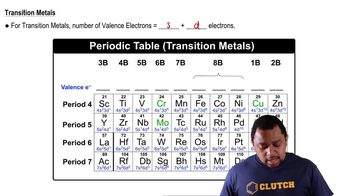
Valence Electrons

Valence electrons are the outermost electrons of an atom and are crucial for chemical bonding. In the context of ethyl acetate, understanding how many valence electrons are available helps determine how they are shared or transferred during bond formation. Each atom's valence electrons contribute to the overall structure and reactivity of the molecule.
Video consigliato:
Percorso guidato
02:12
Transition Metals Valence Electrons

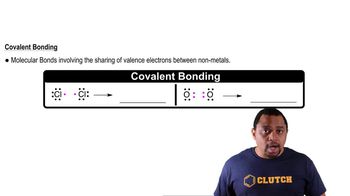
Covalent Bonds

Covalent bonds are formed when two atoms share pairs of valence electrons. In ethyl acetate, these bonds are primarily between carbon and hydrogen, as well as carbon and oxygen. Identifying the number of covalent bonds in the molecule is essential for calculating how many valence electrons are involved in these bonds.
Video consigliato:

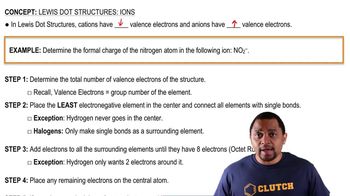
Lewis Structure

A Lewis structure is a diagram that represents the bonding between atoms in a molecule and the lone pairs of electrons. It provides a visual representation of how valence electrons are arranged and helps in identifying the number of bonds formed. Analyzing the Lewis structure of ethyl acetate allows for a clear understanding of how many valence electrons are used in sigma bonds.
Video consigliato:
Percorso guidato
04:28
Lewis Dot Structures: Ions