Ch.9 - Molecular Geometry and Bonding Theories
Brown - Chemistry: The Central Science 14th Edition
Brown14th EditionChemistry: The Central ScienceISBN: 9780134414232Non è quello che usi tu?Cambia libro di testo
Capitolo 9, Problema 7d

In the hydrocarbon
Diagram of a hydrocarbon showing bond angles labeled A, B, C, D, and E, highlighting 120° angles.
(d) Identify all the 120° bond angles in the molecule.

Guida verificata passo dopo passo
1
Identify the regions in the molecule where the carbon atoms are sp2 hybridized, as these will have bond angles of approximately 120°.
Look at the diagram and locate the bond angles labeled A, B, C, D, and E.
Determine which of these angles are formed by sp2 hybridized carbons.
Recognize that sp2 hybridized carbons are typically found in double bonds or in a trigonal planar arrangement.
Identify the bond angles that are approximately 120° based on the molecular geometry and hybridization.

Risposta video verificata per un problema simile:

Questa soluzione video è stata consigliata dai nostri tutor come utile per risolvere questo problema.
Durata del video:
2m

Concetti chiave

Ecco i concetti essenziali che devi comprendere per rispondere correttamente alla domanda.

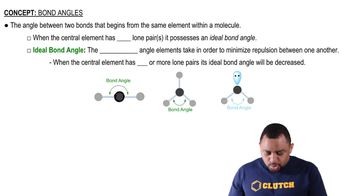
Bond Angles

Bond angles are the angles formed between two adjacent bonds at a central atom in a molecule. They are crucial for understanding molecular geometry and the spatial arrangement of atoms. In hydrocarbons, bond angles can vary depending on the hybridization of the carbon atoms involved, with common angles being 109.5° for tetrahedral, 120° for trigonal planar, and 180° for linear geometries.
Video consigliato:

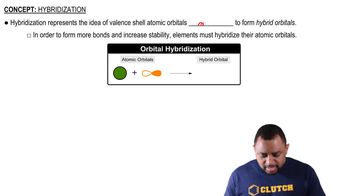
Hybridization

Hybridization is the concept that describes the mixing of atomic orbitals to form new hybrid orbitals, which can explain the geometry of molecular bonding. In hydrocarbons, carbon atoms can undergo sp, sp², or sp³ hybridization, leading to different bond angles. For example, sp hybridization results in a linear arrangement with 180° angles, while sp² leads to trigonal planar arrangements with 120° angles.
Video consigliato:

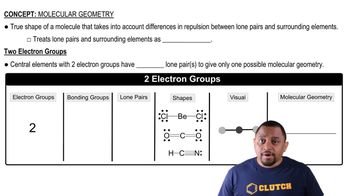
Molecular Geometry

Molecular geometry refers to the three-dimensional arrangement of atoms within a molecule. It is determined by the number of bonding pairs and lone pairs of electrons around the central atom. Understanding molecular geometry is essential for predicting the bond angles and overall shape of the molecule, which is particularly relevant in hydrocarbons where multiple bond types (single, double, triple) influence the structure.
Video consigliato:
Percorso guidato
01:33
Molecular Geometry with Two Electron Groups
Pratica correlata
Domanda del libro di testo

In the hydrocarbon (b) How many s bonds are there in the molecule?

449
views

Domanda del libro di testo

The molecule shown below is called furan. It is represented in typical shorthand way for organic molecules, with hydrogen atoms not shown, and each of the 4 vertices representing a carbon atom.

(e) The C—C—C bond angles in furan are much smaller than those in benzene. The likely reason is which of the following: (i) The hybridization of the carbon atoms in furan is different from that in benzene, (ii) Furan does not have another resonance structure equivalent to the one above, or (iii) The atoms in a five-membered ring are forced to adopt smaller angles than in a six-membered ring.

946
views
Domanda del libro di testo

The drawing below shows the overlap of two hybrid orbitals to form a bond in a hydrocarbon. (a) Which of the following types of bonds is being formed: (i) C¬C s, (ii) C¬C p, or (iii) C¬H s?

464
views
Domanda del libro di testo

In the hydrocarbon

(a) What is the hybridization at each carbon atom in the molecule?

599
views
Domanda del libro di testo

The drawing below shows the overlap of two hybrid orbitals to form a bond in a hydrocarbon. (b) Which of the following could be the identity of the hydrocarbon: (i) CH4, (ii) C2H6, (iii) C2H4, or (iv) C2H2?

763
views
Domanda del libro di testo

The orbital diagram that follows presents the final step in the formation of hybrid orbitals by a silicon atom. (b) What type of hybrid orbital is produced in this hybridization?

668
views