Ch.9 - Molecular Geometry and Bonding Theories
Brown - Chemistry: The Central Science 14th Edition
Brown14th EditionChemistry: The Central ScienceISBN: 9780134414232Non è quello che usi tu?Cambia libro di testo
Capitolo 9, Problema 4c

The molecule shown here is difluoromethane 1CH2F22, which is used as a refrigerant called R-32. (c) If the molecule is polar, which of the following describes the direction of the overall dipole moment vector in the molecule: (i) from the carbon atom toward a fluorine atom, (ii) from the carbon atom to a point midway between the fluorine atoms, (iii) from the carbon atom to a point midway between the hydrogen atoms, or (iv) from the carbon atom toward a hydrogen atom?
3D model of difluoromethane showing molecular structure for polarity analysis.

Guida verificata passo dopo passo
1
Identify the atoms in the molecule: Carbon (C) is the central atom, with two Fluorine (F) atoms and two Hydrogen (H) atoms bonded to it.
Determine the electronegativity of each atom: Fluorine is more electronegative than Carbon, and Carbon is more electronegative than Hydrogen.
Analyze the bond dipoles: The C-F bonds will have dipoles pointing from Carbon to Fluorine, and the C-H bonds will have dipoles pointing from Hydrogen to Carbon.
Consider the molecular geometry: Difluoromethane (CH2F2) has a tetrahedral shape, with the dipoles of the C-F bonds being stronger than those of the C-H bonds.
Determine the overall dipole moment: The overall dipole moment vector will point from the Carbon atom toward a point midway between the two Fluorine atoms, as the combined effect of the two C-F dipoles dominates the molecular polarity.

Risposta video verificata per un problema simile:

Questa soluzione video è stata consigliata dai nostri tutor come utile per risolvere questo problema.
Durata del video:
1m

Concetti chiave

Ecco i concetti essenziali che devi comprendere per rispondere correttamente alla domanda.

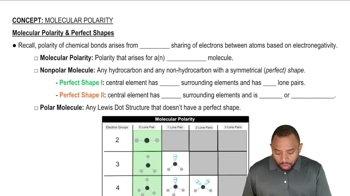
Molecular Polarity

Molecular polarity arises from the distribution of electrical charge across a molecule. A molecule is polar if it has a net dipole moment due to differences in electronegativity between atoms, leading to uneven charge distribution. In difluoromethane, the fluorine atoms are more electronegative than carbon and hydrogen, creating a dipole moment that points toward the fluorine atoms.
Video consigliato:
Percorso guidato
02:38
Molecular Polarity

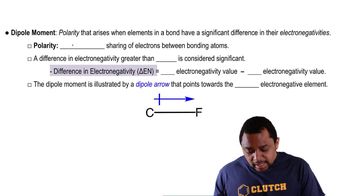
Dipole Moment

The dipole moment is a vector quantity that represents the separation of positive and negative charges in a molecule. It is defined as the product of the charge and the distance between the charges. In the case of difluoromethane, the dipole moment vector points from the carbon atom toward the more electronegative fluorine atoms, indicating the direction of the overall charge distribution.
Video consigliato:

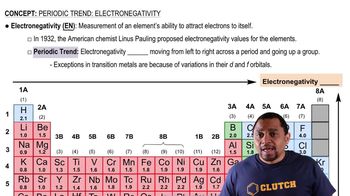
Electronegativity

Electronegativity is a measure of an atom's ability to attract and hold onto electrons within a chemical bond. In difluoromethane, fluorine has a significantly higher electronegativity than carbon and hydrogen, which influences the molecule's polarity. This difference in electronegativity leads to the formation of polar bonds, contributing to the overall dipole moment of the molecule.
Video consigliato:
Percorso guidato
02:10
Electronegativity Trends