Ch.9 - Molecular Geometry and Bonding Theories
Brown - Chemistry: The Central Science 14th Edition
Brown14th EditionChemistry: The Central ScienceISBN: 9780134414232Non è quello che usi tu?Cambia libro di testo
Capitolo 9, Problema 52a,b

What is the hybridization of the central atom in (a) PBr5? (b) CH2O?

Guida verificata passo dopo passo
1
Step 1: Draw the Lewis structure of the molecule. For PBr5, the central atom is Phosphorus (P) and it is surrounded by five Bromine (Br) atoms.
Step 2: Count the number of atoms bonded to the central atom. In PBr5, there are five Bromine atoms bonded to the central Phosphorus atom.
Step 3: Count the number of lone pairs on the central atom. In PBr5, Phosphorus does not have any lone pairs.
Step 4: Add the number of atoms bonded to the central atom and the number of lone pairs. In PBr5, this gives us a total of 5 (5 bonded atoms + 0 lone pairs).
Step 5: Determine the hybridization based on this number. If the total is 2, the hybridization is sp. If the total is 3, the hybridization is sp2. If the total is 4, the hybridization is sp3. If the total is 5, the hybridization is sp3d. If the total is 6, the hybridization is sp3d2. In the case of PBr5, the hybridization of the central Phosphorus atom is sp3d.

Risposta video verificata per un problema simile:

Questa soluzione video è stata consigliata dai nostri tutor come utile per risolvere questo problema.
Durata del video:
2m

Concetti chiave

Ecco i concetti essenziali che devi comprendere per rispondere correttamente alla domanda.

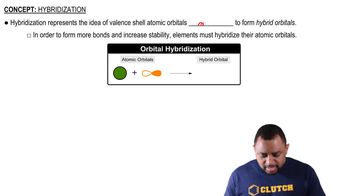
Hybridization

Hybridization is a concept in chemistry that describes the mixing of atomic orbitals to form new hybrid orbitals. These hybrid orbitals are used to explain the geometry and bonding properties of molecules. The type of hybridization depends on the number of electron pairs around the central atom, influencing molecular shape and bond angles.
Video consigliato:

Valence Shell Electron Pair Repulsion (VSEPR) Theory

VSEPR theory is a model used to predict the geometry of individual molecules based on the repulsion between electron pairs in the valence shell of the central atom. According to this theory, electron pairs will arrange themselves as far apart as possible to minimize repulsion, which helps determine the molecular shape and the hybridization of the central atom.
Video consigliato:
Percorso guidato
00:47
Valence Shell Electron Pair Repulsion Theory

Molecular Geometry of PBr5

PBr5, or phosphorus pentabromide, has a trigonal bipyramidal molecular geometry. In this structure, the phosphorus atom is surrounded by five bromine atoms, leading to a hybridization of sp3d. This hybridization accounts for the five bonding pairs of electrons and the specific arrangement of atoms in three-dimensional space.
Video consigliato:
Percorso guidato
01:33
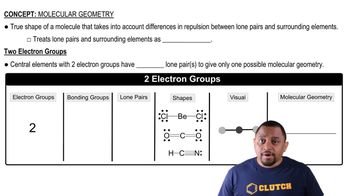
Molecular Geometry with Two Electron Groups