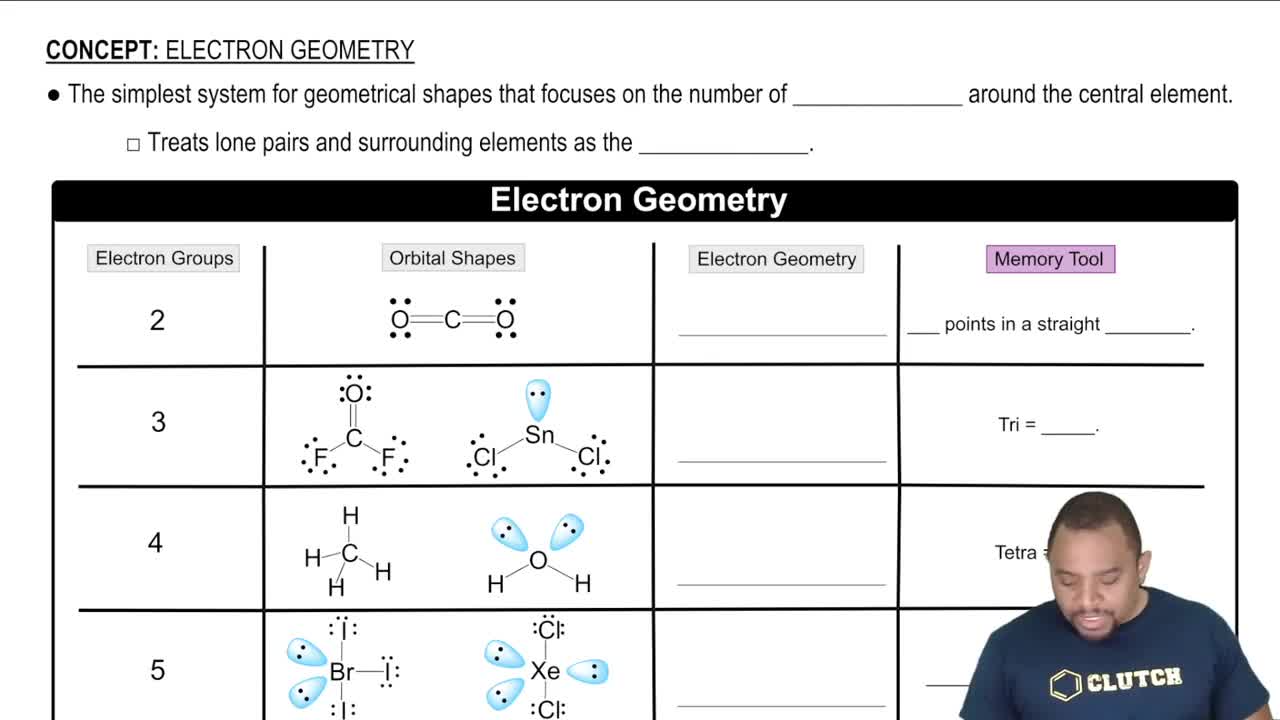
(b) An AB4 molecule has two lone pairs of electrons on the A atom (in addition to the four B atoms). What is the electron-domain geometry around the A atom?
Ch.9 - Molecular Geometry and Bonding Theories
Brown14th EditionChemistry: The Central ScienceISBN: 9780134414232Non è quello che usi tu?Cambia libro di testo
Capitolo 9, Problema 18
Would you expect the nonbonding electron-pair domain in NCl3 to be greater or smaller in size than the corresponding one in PCl3?
Guida verificata passo dopo passo1
Identify the central atoms in both NCl3 and PCl3. In NCl3, the central atom is nitrogen (N), and in PCl3, the central atom is phosphorus (P).
Consider the periodic table positions of nitrogen and phosphorus. Nitrogen is in period 2, and phosphorus is in period 3, which means phosphorus has a larger atomic size due to an additional electron shell.
Understand electron-pair repulsion in the context of VSEPR theory. Electron pairs around the central atom repel each other and try to stay as far apart as possible, affecting the shape and size of the electron cloud.
Compare the effect of the atomic size on the nonbonding electron pairs. Since phosphorus is larger than nitrogen, the electron cloud around phosphorus can spread out more, potentially accommodating larger bonding and nonbonding domains.
Conclude that the nonbonding electron-pair domain in PCl3 is likely to be larger than that in NCl3 due to the larger size of the phosphorus atom compared to nitrogen, allowing more space for electron cloud expansion.

Risposta video verificata per un problema simile:
Questa soluzione video è stata consigliata dai nostri tutor come utile per risolvere questo problema.
Durata del video:
3mConcetti chiave
Ecco i concetti essenziali che devi comprendere per rispondere correttamente alla domanda.
Electron Pair Geometry
Electron pair geometry refers to the spatial arrangement of all electron pairs (bonding and nonbonding) around a central atom. In molecules like NCl3 and PCl3, the geometry is influenced by the number of electron pairs, which can affect the size and shape of the electron domains. Understanding this concept helps predict molecular shapes and the relative sizes of nonbonding electron pairs.
Video consigliato:
Percorso guidato
Electron Geometry
Nonbonding Electron Pairs
Nonbonding electron pairs, or lone pairs, are pairs of valence electrons that are not involved in bonding with other atoms. These pairs occupy space around the central atom and can influence molecular geometry and bond angles. In comparing NCl3 and PCl3, the presence and size of these nonbonding pairs are crucial for understanding their spatial characteristics.
Video consigliato:
Percorso guidato
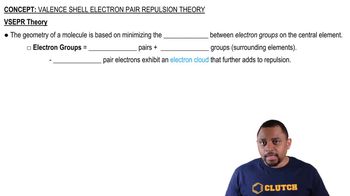
Valence Shell Electron Pair Repulsion Theory
Atomic Size and Electronegativity
Atomic size and electronegativity are key factors that influence the behavior of atoms in a molecule. Nitrogen (N) is smaller and more electronegative than phosphorus (P), which affects the size of the nonbonding electron pair domains in NCl3 compared to PCl3. A smaller atom with higher electronegativity can lead to a more compact electron domain, impacting the overall molecular structure.
Video consigliato:
Percorso guidato
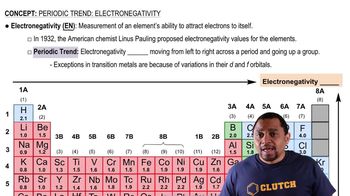
Electronegativity Trends
Pratica correlata
Domanda del libro di testo
1283
views
Domanda del libro di testo
Describe the bond angles to be found in each of the following molecular structures: (a) trigonal planar, (b) tetrahedral, (c) octahedral, (d) linear.
1071
views
Domanda del libro di testo
(a) An AB6 molecule has no lone pairs of electrons on the A atom. What is its molecular geometry? (c) For the AB4 molecule in part (b), predict the molecular geometry.
Domanda del libro di testo
In which of the following molecules can you confidently predict the bond angles about the central atom, and for which would you be a bit uncertain? Explain in each case. (a) H2S, (b) BCl3, (c) CH3I, (d) CBr4, (e) TeBr4.
1245
views
Domanda del libro di testo
How many nonbonding electron pairs are there in each of the following molecules: (a) (CH3)2S (c) BF3 (d) SO2
1654
views
1
rank