Ch.1 - Introduction: Matter, Energy, and Measurement
Brown - Chemistry: The Central Science 15th Edition
Brown15th EditionChemistry: The Central ScienceISBN: 9780137542970Non è quello che usi tu?Cambia libro di testo
Capitolo 1, Problema 37b

(b) Carbon dioxide (CO2) is a gas at room temperature and pressure. However, carbon dioxide can be put under pressure to become a 'supercritical fluid' that is a much safer dry-cleaning agent than tetrachloroethylene. At a certain pressure, the density of supercritical CO2 is 0.469 g/cm3. What is the mass of a 25.0-mL sample of supercritical CO2 at this pressure?

Guida verificata passo dopo passo
1
Identify the given values: density of supercritical CO_2 is 0.469 g/cm^3 and the volume of the sample is 25.0 mL.
Recall the formula for mass using density and volume: \( \text{mass} = \text{density} \times \text{volume} \).
Substitute the given values into the formula: \( \text{mass} = 0.469 \, \text{g/cm}^3 \times 25.0 \, \text{mL} \).
Note that 1 mL is equivalent to 1 cm^3, so the units are consistent and will cancel appropriately.
Perform the multiplication to find the mass of the supercritical CO_2 sample.

Risposta video verificata per un problema simile:

Questa soluzione video è stata consigliata dai nostri tutor come utile per risolvere questo problema.
Durata del video:
3m

Concetti chiave

Ecco i concetti essenziali che devi comprendere per rispondere correttamente alla domanda.

Density

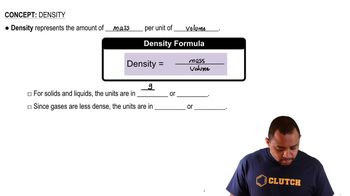
Density is defined as mass per unit volume, typically expressed in grams per cubic centimeter (g/cm³). It is a crucial property that helps determine how much mass is contained in a given volume of a substance. In this question, the density of supercritical CO₂ is provided, allowing us to calculate the mass of a specific volume of the substance.
Video consigliato:
Percorso guidato
01:56
Density Concepts

Supercritical Fluids

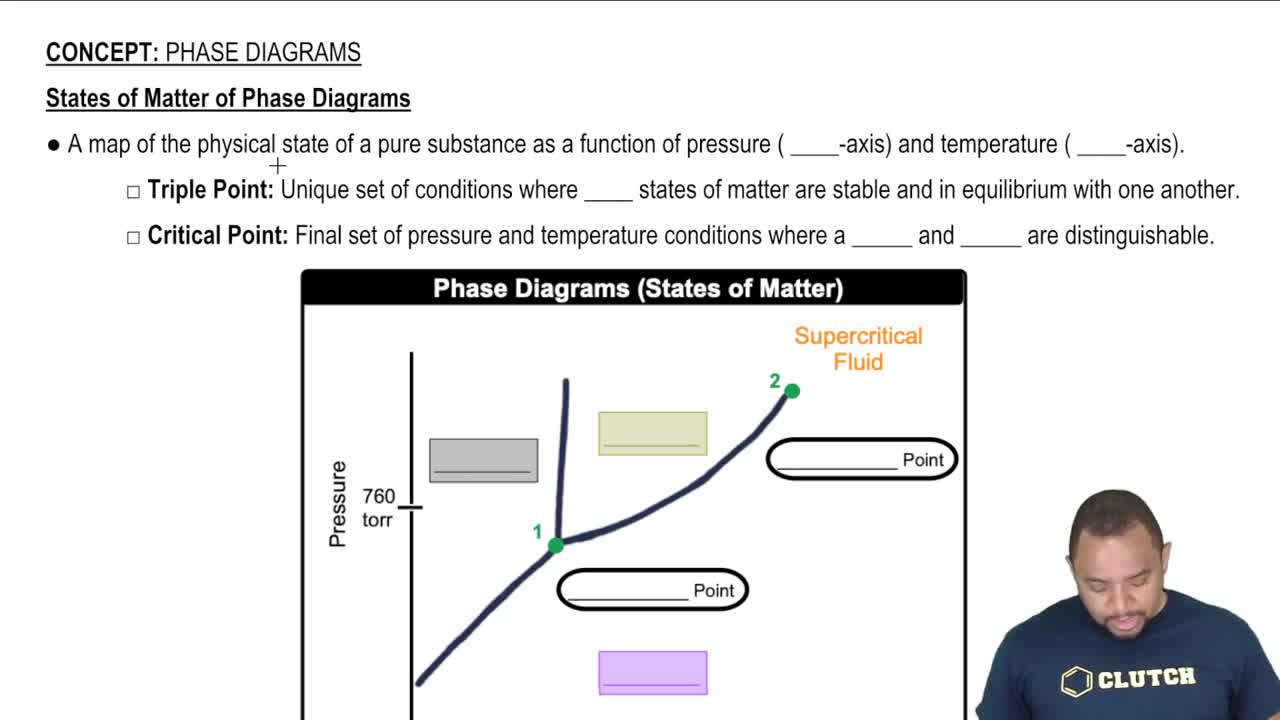
Supercritical fluids occur when a substance is subjected to temperature and pressure above its critical point, resulting in unique properties that are distinct from gases and liquids. Supercritical CO₂, for example, can dissolve materials like a liquid while maintaining the diffusivity of a gas, making it useful in applications such as dry cleaning. Understanding this concept is essential for grasping the context of the question.
Video consigliato:
Percorso guidato
03:19
States of Matter of Phase Diagrams

Mass Calculation

Mass calculation involves using the formula mass = density × volume. In this scenario, knowing the density of supercritical CO₂ and the volume of the sample allows us to compute the mass. This fundamental relationship is key to solving the problem presented in the question.
Video consigliato:
Percorso guidato
03:12
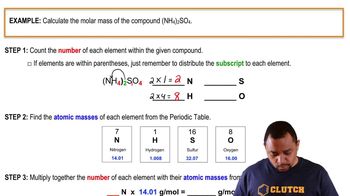
Molar Mass Calculation Example
Pratica correlata
Domanda del libro di testo

Many scientific data are reported at 25 °C. What is this temperature in kelvins and in degrees Fahrenheit?

2
views

Domanda del libro di testo

b. An experiment requires 78.1 g of benzene, a liquid whose density is 0.876 g/mL. Rather than weigh the sample on a balance, a chemist chooses to dispense the liquid using a graduated cylinder. What volume of the liquid should he use?

3
views
Domanda del libro di testo

(a) A sample of tetrachloroethylene, a liquid used in dry cleaning that is being phased out because of its potential to cause cancer, has a mass of 40.55 g and a volume of 25.0 mL at 25 °C. What is its density at this temperature? Will tetrachloroethylene float on water? (Materials that are less dense than water will float.)

1302
views
Domanda del libro di testo

The temperature on a warm summer day is 87 °F. What is the temperature in °C?

2
views
Domanda del libro di testo

c. A cubic piece of metal measures 5.00 cm on each edge. If the metal is nickel, whose density is 8.90 g/cm3, what is the mass of the cube?

3
views
Domanda del libro di testo

(a) To identify a liquid substance, a student determined its density. Using a graduated cylinder, she measured out a 45-mL sample of the substance. She then measured the mass of the sample, finding that it weighed 38.5 g. She knew that the substance had to be either isopropyl alcohol 1density 0.785 g/mL2 or toluene (density 0.866 g/mL). What are the calculated density and the probable identity of the substance?

1320
views