Ch.1 - Introduction: Matter, Energy, and Measurement
Brown - Chemistry: The Central Science 15th Edition
Brown15th EditionChemistry: The Central ScienceISBN: 9780137542970Non è quello che usi tu?Cambia libro di testo
Capitolo 1, Problema 34g

Use appropriate metric prefixes to write the following measurements without use of exponents: g. 5.1×102 cm

Guida verificata passo dopo passo
1
Identify the metric prefix that corresponds to the exponent given in the problem. In this case, 10^2 corresponds to the prefix 'hecto-', which is used for 100.
Rewrite the measurement using the identified metric prefix. Since 5.1 × 10^2 cm is equivalent to 5.1 hecto-centimeters, you can express it as 5.1 hectocentimeters.
Alternatively, convert the measurement to a more commonly used metric unit if needed. For example, since 1 meter is 100 centimeters, you can convert 5.1 × 10^2 cm to meters by dividing by 100.
Perform the conversion by dividing 5.1 × 10^2 cm by 100 to express the measurement in meters.
Write the final measurement in meters without using exponents, ensuring clarity and precision in the expression.

Risposta video verificata per un problema simile:

Questa soluzione video è stata consigliata dai nostri tutor come utile per risolvere questo problema.
Durata del video:
53s

Concetti chiave

Ecco i concetti essenziali che devi comprendere per rispondere correttamente alla domanda.

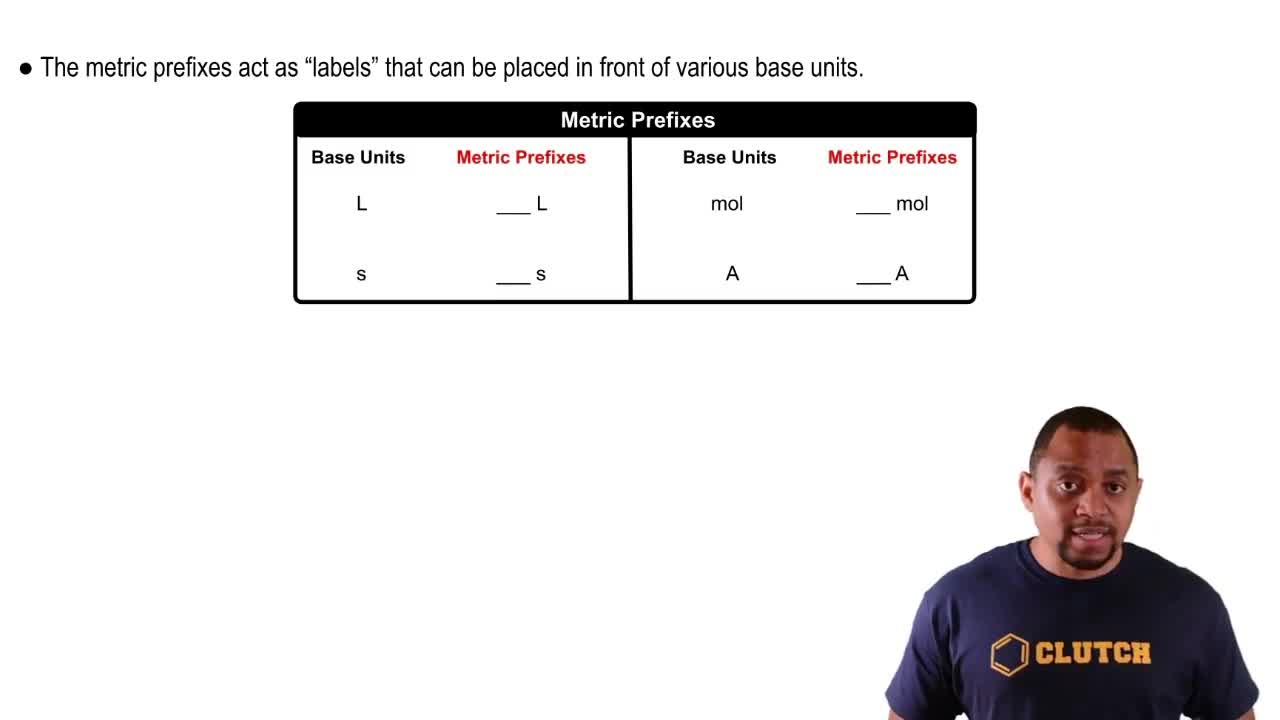
Metric Prefixes

Metric prefixes are standardized terms used to denote specific powers of ten in the metric system. They simplify the representation of large or small quantities by providing a shorthand way to express these values. For example, 'centi-' represents one-hundredth (10^-2), so 5.1×10^2 cm can be expressed as 5.1 m when converted to meters.
Video consigliato:
Percorso guidato
01:16
Metric Prefixes Usage

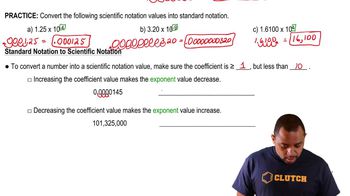
Scientific Notation

Scientific notation is a method of expressing numbers as a product of a coefficient and a power of ten. It is particularly useful for handling very large or very small numbers. In the given measurement, 5.1×10^2 cm indicates that the value is 5.1 multiplied by 100, which equals 510 cm, and can be converted to a more manageable metric prefix.
Video consigliato:
Percorso guidato
02:50
Standard Notation to Scientific Notation

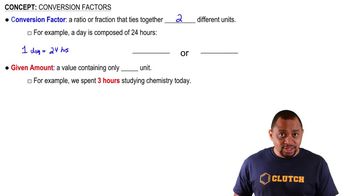
Unit Conversion

Unit conversion involves changing a measurement from one unit to another while maintaining the same quantity. In this case, converting centimeters to meters requires knowing the relationship between these units, specifically that 1 m equals 100 cm. Thus, to convert 510 cm to meters, you divide by 100, resulting in 5.1 m.
Video consigliato:
Percorso guidato
01:56
Conversion Factors