Ch.1 - Introduction: Matter, Energy, and Measurement
Brown - Chemistry: The Central Science 15th Edition
Brown15th EditionChemistry: The Central ScienceISBN: 9780137542970Non è quello che usi tu?Cambia libro di testo
Capitolo 1, Problema 35e

Make the following conversions: e. 2500 °F to K

Guida verificata passo dopo passo
1
Start by converting the temperature from Fahrenheit (°F) to Celsius (°C) using the formula: \( °C = \frac{5}{9} (°F - 32) \).
Substitute 2500 °F into the formula: \( °C = \frac{5}{9} (2500 - 32) \).
Calculate the value inside the parentheses: \( 2500 - 32 \).
Multiply the result by \( \frac{5}{9} \) to find the temperature in Celsius.
Convert the temperature from Celsius to Kelvin (K) using the formula: \( K = °C + 273.15 \).

Risposta video verificata per un problema simile:

Questa soluzione video è stata consigliata dai nostri tutor come utile per risolvere questo problema.
Durata del video:
1m

Concetti chiave

Ecco i concetti essenziali che devi comprendere per rispondere correttamente alla domanda.

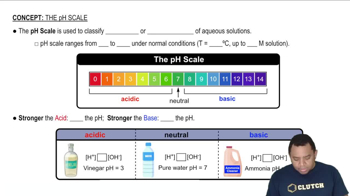
Temperature Scales

Temperature can be measured in different scales, primarily Fahrenheit (°F), Celsius (°C), and Kelvin (K). Each scale has its own zero point and degree increments. Understanding how these scales relate to one another is crucial for converting temperatures accurately.
Video consigliato:

Conversion Formulas

To convert temperatures between different scales, specific formulas are used. For example, to convert Fahrenheit to Kelvin, one must first convert Fahrenheit to Celsius using the formula °C = (°F - 32) × 5/9, and then convert Celsius to Kelvin using K = °C + 273.15. Mastery of these formulas is essential for accurate conversions.
Video consigliato:
Percorso guidato
01:56
Conversion Factors

Absolute Zero

Kelvin is an absolute temperature scale where 0 K represents absolute zero, the theoretical point where all molecular motion ceases. This concept is important because it provides a baseline for temperature measurements, and understanding it helps in grasping the significance of temperature in scientific contexts.
Video consigliato:
Percorso guidato
02:44
Zero-Order Reactions