
A watt is a measure of power (the rate of energy change) equal to 1 J/s. (b) An adult person radiates heat to the surroundings at about the same rate as a 100-watt electric incandescent light bulb. What is the total amount of energy in kcal radiated to the surroundings by an adult over a 24 h period?
Ch.1 - Introduction: Matter, Energy, and Measurement

Brown15th EditionChemistry: The Central ScienceISBN: 9780137542970Non è quello che usi tu?Cambia libro di testo
Tutti i libri di testo
Brown 15th Edition
Ch.1 - Introduction: Matter, Energy, and Measurement
Problema 85a
Brown 15th Edition
Ch.1 - Introduction: Matter, Energy, and Measurement
Problema 85aCapitolo 1, Problema 85a
Two spheres of equal volume are placed on the scales as shown. a. Which one is more dense?
Guida verificata passo dopo passo1
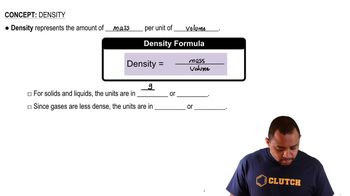
Identify the concept of density: Density is defined as mass per unit volume, expressed as \( \rho = \frac{m}{V} \).
Recognize that both spheres have equal volume, meaning \( V_1 = V_2 \).
Understand that the density of each sphere depends on its mass, since the volumes are equal.
Observe the scales: The sphere that causes the scale to tip more is the one with greater mass.
Conclude that the sphere with greater mass is more dense, as density is directly proportional to mass when volume is constant.

Risposta video verificata per un problema simile:
Questa soluzione video è stata consigliata dai nostri tutor come utile per risolvere questo problema.
Durata del video:
1mConcetti chiave
Ecco i concetti essenziali che devi comprendere per rispondere correttamente alla domanda.
Density
Density is defined as mass per unit volume, typically expressed in grams per cubic centimeter (g/cm³). It is a physical property that indicates how much matter is packed into a given space. In this scenario, comparing the density of the two spheres involves determining which one has a greater mass while maintaining the same volume.
Video consigliato:
Percorso guidato
Density Concepts
Mass
Mass is a measure of the amount of matter in an object, usually measured in grams or kilograms. It is an intrinsic property that does not change regardless of the object's location. In the context of the question, the mass of each sphere is crucial for determining their respective densities, as density is calculated by dividing mass by volume.
Video consigliato:
Percorso guidato
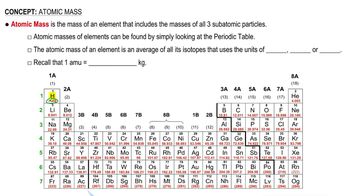
Atomic Mass
Volume
Volume is the amount of space an object occupies, typically measured in cubic centimeters (cm³) or liters. For the two spheres mentioned, since they are stated to have equal volume, this factor remains constant when comparing their densities. Understanding volume is essential for calculating density, as it serves as the denominator in the density formula.
Video consigliato:
Percorso guidato
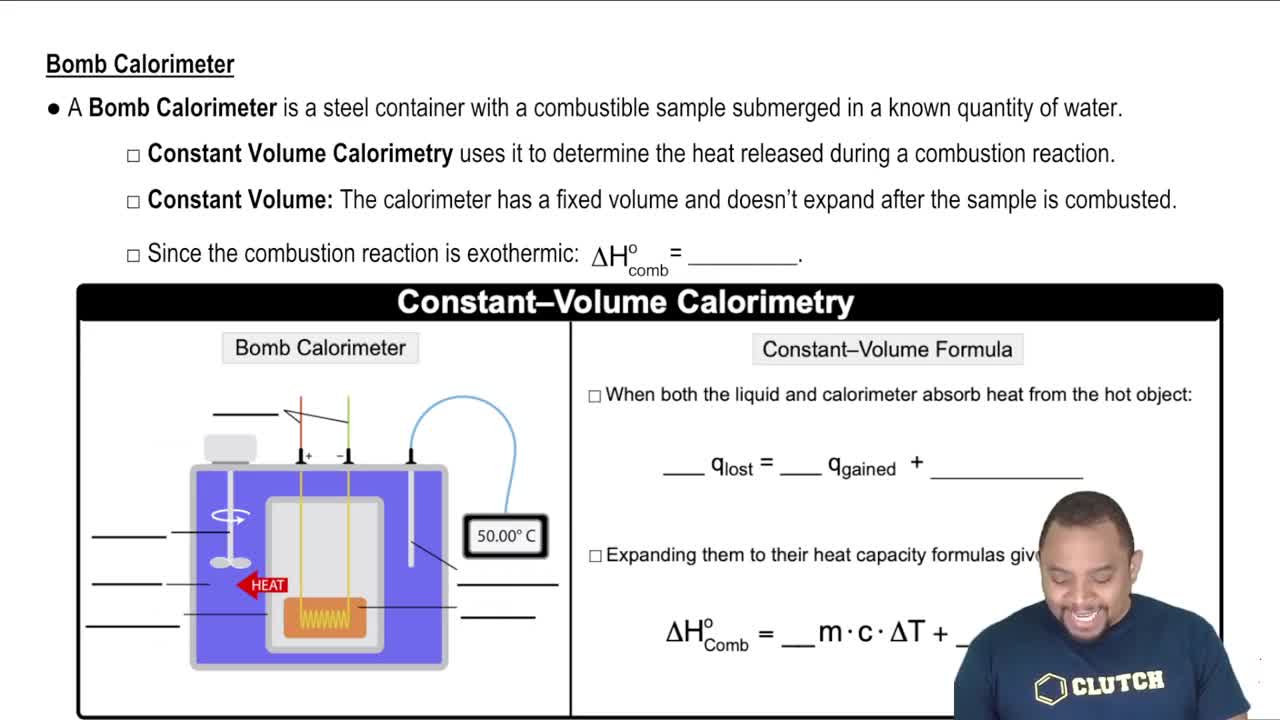
Constant-Volume Calorimetry
Pratica correlata
Domanda del libro di testo
1155
views
Domanda del libro di testo
A 32.65-g sample of a solid is placed in a flask. Toluene, in which the solid is insoluble, is added to the flask so that the total volume of solid and liquid together is 50.00 mL. The solid and toluene together weigh 58.58 g. The density of toluene at the temperature of the experiment is 0.864 g/mL. What is the density of the solid?
1168
views
Domanda del libro di testo
Water has a density of 0.997 g/cm3 at 25 °C; ice has a density of 0.917 g/cm3 at -10 °C. (a) If a soft-drink bottle whose volume is 1.50 L is completely filled with water and then frozen to -10 °C, what volume does the ice occupy? (b) Can the ice be contained within the bottle?
5303
views
1
rank