
Ch.10 - Gases
Brown - Chemistry: The Central Science 15th Edition
Brown15th EditionChemistry: The Central ScienceISBN: 9780137542970Non è quello che usi tu?Cambia libro di testo
Capitolo 10, Problema 16

A set of bookshelves rests on a hard floor surface on four legs, each having a cross-sectional dimension of 3.0×4.1 cm in contact with the floor. The total mass of the shelves plus the books stacked on them is 262 kg. Calculate the pressure in pascals exerted by the shelf footings on the surface.

Guida verificata passo dopo passo
1
Convert the cross-sectional dimensions of each leg from centimeters to meters by dividing each dimension by 100.
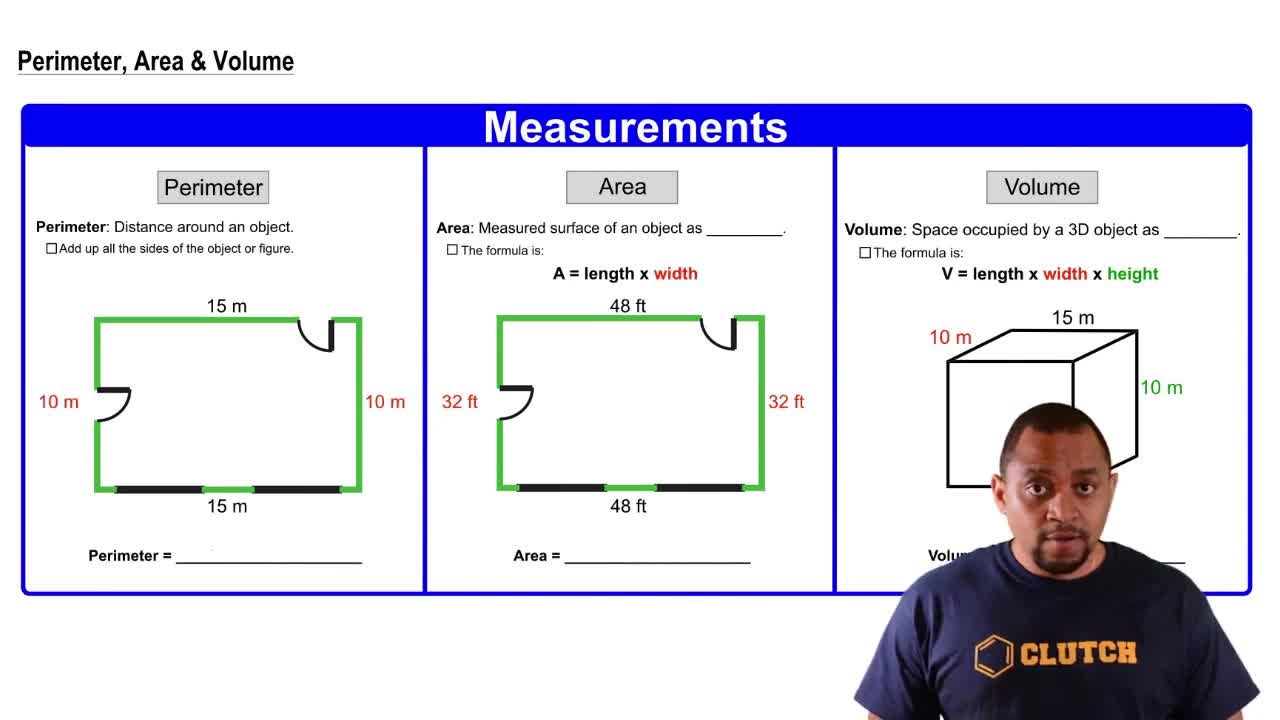
Calculate the area of contact for one leg by multiplying the converted dimensions (in meters).
Multiply the area of one leg by 4 to find the total contact area for all four legs.
Calculate the force exerted by the shelves using the formula: Force (N) = mass (kg) × acceleration due to gravity (9.8 m/s²).
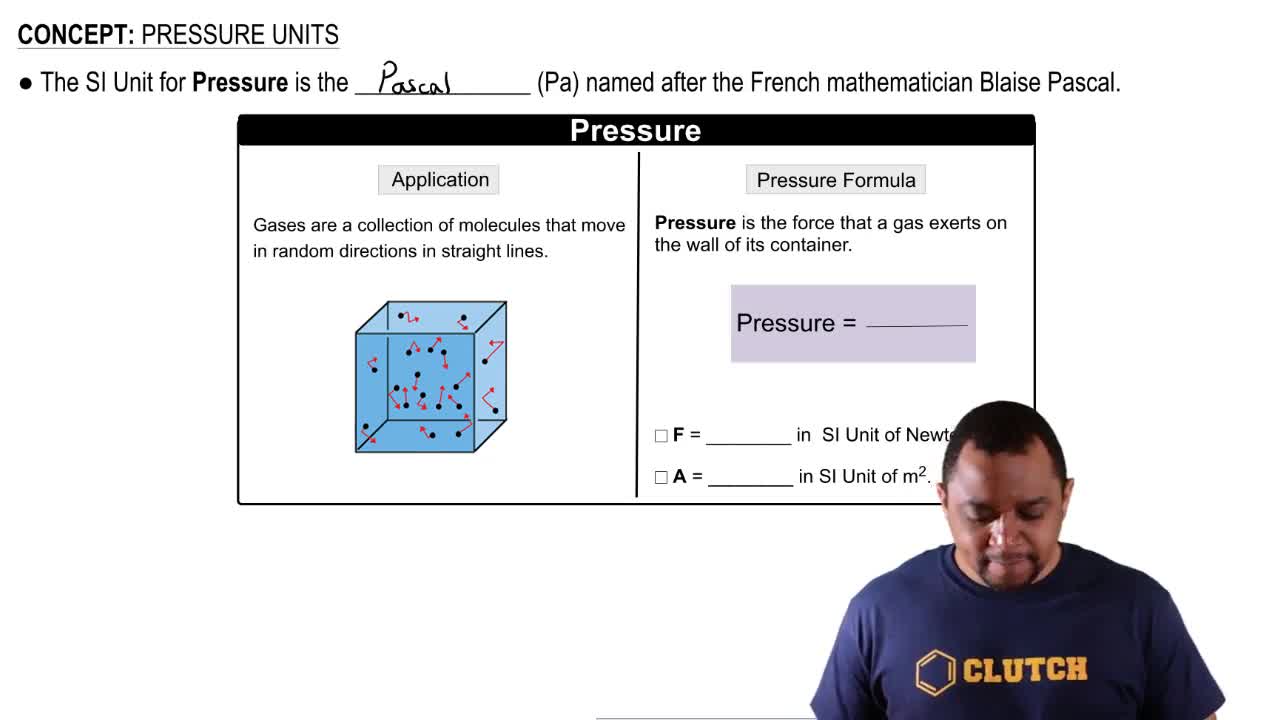
Determine the pressure exerted by dividing the total force by the total contact area, using the formula: Pressure (Pa) = Force (N) / Area (m²).

Risposta video verificata per un problema simile:

Questa soluzione video è stata consigliata dai nostri tutor come utile per risolvere questo problema.
Durata del video:
2m

Concetti chiave

Ecco i concetti essenziali che devi comprendere per rispondere correttamente alla domanda.

Pressure

Pressure is defined as the force exerted per unit area. In the context of this question, it is calculated using the formula P = F/A, where P is pressure, F is the force (in this case, the weight of the bookshelves), and A is the area of contact with the floor. Understanding this concept is crucial for determining how the weight of the shelves translates into pressure on the floor.
Video consigliato:

Force and Weight

Force is a vector quantity that causes an object to accelerate, and weight is the force exerted by gravity on an object. The weight of the bookshelves can be calculated using the formula W = mg, where m is the mass and g is the acceleration due to gravity (approximately 9.81 m/s²). This concept is essential for finding the total force acting on the floor, which is necessary for calculating pressure.
Video consigliato:
Percorso guidato
06:44
Types of Intermolecular Forces

Area of Contact

The area of contact refers to the surface area over which a force is distributed. In this scenario, the area is determined by the cross-sectional dimensions of the legs of the bookshelf. The area can be calculated by multiplying the width and height of the leg's cross-section. This concept is important because it directly influences the pressure exerted on the floor; a larger area results in lower pressure for the same force.
Video consigliato:
Percorso guidato
03:47
Perimeter, Area, Volume
Pratica correlata
Domanda del libro di testo

Suppose that a woman weighing 130 lb and wearing high-heeled shoes momentarily places all her weight on the heel of one foot. If the area of the heel is 0.50 in.2, calculate the pressure exerted on the underlying surface in c. atmospheres.

2
views
Domanda del libro di testo

(a) The compound 1-iodododecane is a nonvolatile liquid with a density of 1.20 g>mL. The density of mercury is 13.6 g>mL. What do you predict for the height of a barometer column based on 1-iodododecane, when the atmospheric pressure is 749 torr?

656
views
1
rank
Domanda del libro di testo

Suppose that a woman weighing 130 lb and wearing high-heeled shoes momentarily places all her weight on the heel of one foot. If the area of the heel is 0.50 in.2, calculate the pressure exerted on the underlying surface in a. pounds per square inch,

2
views
Domanda del libro di testo

How high in meters must a column of glycerol be to exert a pressure equal to that of a 760-mm column of mercury? The density of glycerol is 1.26 g/mL, whereas that of mercury is 13.6 g/mL.

2
views
Domanda del libro di testo

What pressure, in atmospheres, is exerted on the body of a diver if they are 15 ft below the surface of the water when the atmospheric pressure is 750 torr? Assume that the density of the water is 1.00 g/cm3=1.00×103 kg/m3. The gravitational constant is 9.81 m/s2, and 1 Pa=1 kg/m-s2.

2
views
Domanda del libro di testo

(c) Which is most likely to be a gas at room temperature and ordinary atmospheric pressure, F2, Br2, K2O?

1182
views