
Ch.10 - Gases
Brown - Chemistry: The Central Science 15th Edition
Brown15th EditionChemistry: The Central ScienceISBN: 9780137542970Non è quello che usi tu?Cambia libro di testo
Capitolo 10, Problema 2b

You have a sample of gas in a container with a movable piston, such as the one in the drawing. b. Redraw the container to show what it might look like if the external pressure on the piston is increased from 1.0 atm to 2.0 atm while the temperature is kept constant.

Guida verificata passo dopo passo
1
Identify the initial conditions of the gas: The gas is at an initial pressure of 1.0 atm with a certain volume.
Recognize that the problem involves a change in external pressure from 1.0 atm to 2.0 atm while keeping the temperature constant.
Apply Boyle's Law, which states that for a given amount of gas at constant temperature, the pressure and volume are inversely proportional: \( P_1V_1 = P_2V_2 \).
Understand that increasing the external pressure to 2.0 atm will cause the volume of the gas to decrease, as the piston will move inward to balance the pressure.
Redraw the container with the piston moved inward, indicating a smaller volume of gas, while labeling the new external pressure as 2.0 atm.

Risposta video verificata per un problema simile:

Questa soluzione video è stata consigliata dai nostri tutor come utile per risolvere questo problema.
Durata del video:
1m

Concetti chiave

Ecco i concetti essenziali che devi comprendere per rispondere correttamente alla domanda.

Gas Laws

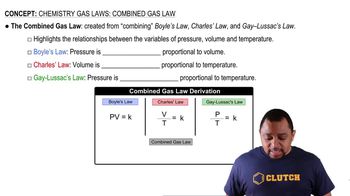
Gas laws describe the behavior of gases in relation to pressure, volume, and temperature. The most relevant here is Boyle's Law, which states that at constant temperature, the pressure of a gas is inversely proportional to its volume. This means that if the pressure increases, the volume must decrease, provided the temperature remains unchanged.
Video consigliato:
Percorso guidato
01:43
Combined Gas Law

Pressure

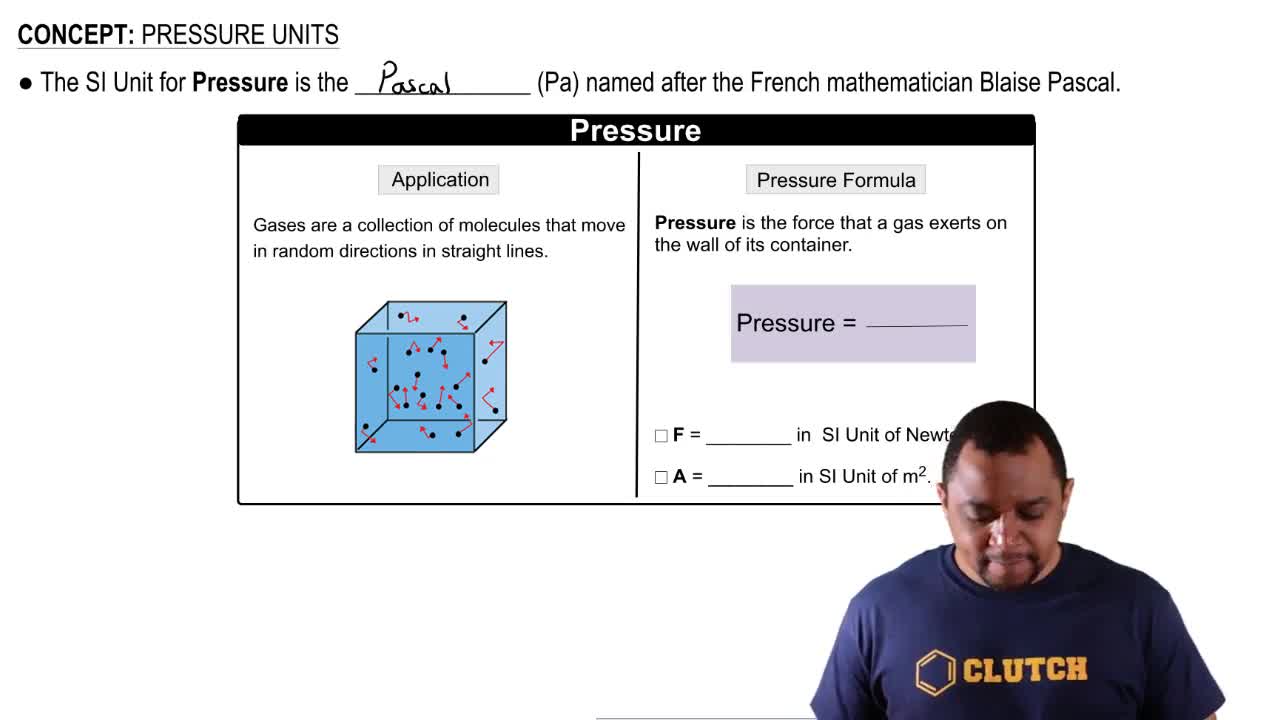
Pressure is defined as the force exerted per unit area. In the context of gases, it is often measured in atmospheres (atm). When external pressure on a gas increases, it compresses the gas, reducing its volume, which is a key aspect to consider when redrawing the container with the piston.
Video consigliato:

Piston Mechanism

A piston mechanism allows for the movement of gas within a container by changing the volume of the gas space. When external pressure is applied to the piston, it moves inward, compressing the gas. Understanding how the piston responds to changes in pressure is crucial for visualizing the gas behavior under different conditions.
Video consigliato:
Percorso guidato
03:06
Reaction Mechanism Overview