

Ch.10 - Gases
Brown - Chemistry: The Central Science 15th Edition
Brown15th EditionChemistry: The Central ScienceISBN: 9780137542970Non è quello che usi tu?Cambia libro di testo
Capitolo 10, Problema 60

Acetylene gas, C2H2(𝑔), can be prepared by the reaction of calcium carbide with water:


CaC2(𝑠)+2 H2O(𝑙)⟶Ca(OH)2(𝑎𝑞)+C2H2(𝑔)
Calculate the volume of C2H2 that is collected over water at 23°C by reaction of 1.524 g of CaC2 if the total pressure of the gas is 753 torr. (The vapor pressure of water is tabulated in Appendix B.)

Guida verificata passo dopo passo
1
Determine the moles of CaC2 by using its molar mass. Use the formula: \( \text{moles} = \frac{\text{mass}}{\text{molar mass}} \).
Use the stoichiometry of the balanced chemical equation to find the moles of C2H2 produced. According to the equation, 1 mole of CaC2 produces 1 mole of C2H2.
Calculate the partial pressure of C2H2 by subtracting the vapor pressure of water at 23°C from the total pressure. Use the formula: \( P_{\text{C2H2}} = P_{\text{total}} - P_{\text{H2O}} \).
Use the ideal gas law to calculate the volume of C2H2. The formula is \( PV = nRT \), where \( P \) is the partial pressure of C2H2, \( V \) is the volume, \( n \) is the moles of C2H2, \( R \) is the ideal gas constant, and \( T \) is the temperature in Kelvin.
Convert the temperature from Celsius to Kelvin by adding 273.15 to the Celsius temperature. Use this temperature in the ideal gas law calculation.

Risposta video verificata per un problema simile:

Questa soluzione video è stata consigliata dai nostri tutor come utile per risolvere questo problema.
Durata del video:
7m

Concetti chiave

Ecco i concetti essenziali che devi comprendere per rispondere correttamente alla domanda.

Stoichiometry

Stoichiometry is the calculation of reactants and products in chemical reactions based on the balanced chemical equation. It allows us to determine the amount of product formed from a given amount of reactant. In this case, knowing the mass of calcium carbide (CaC2) enables us to calculate the moles of acetylene (C2H2) produced using the stoichiometric coefficients from the balanced equation.
Video consigliato:
Percorso guidato
01:16
Stoichiometry Concept

Gas Laws

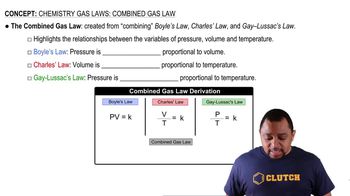
Gas laws describe the behavior of gases in relation to pressure, volume, and temperature. The ideal gas law (PV=nRT) is particularly useful for calculating the volume of a gas under specific conditions. In this question, we need to account for the total pressure and the vapor pressure of water to find the effective pressure of the acetylene gas, which is essential for determining its volume.
Video consigliato:
Percorso guidato
01:43
Combined Gas Law

Vapor Pressure of Water

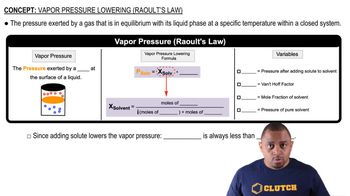
The vapor pressure of water is the pressure exerted by water vapor in equilibrium with its liquid at a given temperature. It is crucial to consider this when collecting gases over water, as the total pressure measured includes both the gas of interest and the water vapor. By subtracting the vapor pressure of water from the total pressure, we can isolate the pressure of the acetylene gas, allowing for accurate volume calculations.
Video consigliato:
Percorso guidato
02:40
Raoult's Law and Vapor Pressure
Pratica correlata
Domanda del libro di testo

Calcium hydride, CaH2, reacts with water to form hydrogen gas:


CaH2(𝑠)+2 H2O(𝑙)⟶Ca(OH)2(𝑎𝑞)+2 H2(𝑔)

This reaction is sometimes used to inflate life rafts, weather balloons, and the like, when a simple, compact means of generating H2 is desired. How many grams of CaH2 are needed to generate 145 L of H2 gas if the pressure of H2 is 825 torr at 21°C?

Domanda del libro di testo

Consider the apparatus shown in the following drawing. (a) When the valve between the two containers is opened and the gases are allowed to mix, what is the partial pressure of N2 after mixing?

1135
views
Domanda del libro di testo

Consider the apparatus shown in the following drawing. (a) When the valve between the two containers is opened and the gases are allowed to mix, how does the volume occupied by the N2 gas change?

683
views
Domanda del libro di testo

Consider a mixture of two gases, A and B, confined in a closed vessel. A quantity of a third gas, C, is added to the same vessel at the same temperature. How does the addition of gas C affect the following: (a) the partial pressure of gas A?

835
views
Domanda del libro di testo

Both Jacques Charles and Joseph Louis Guy-Lussac were avid balloonists. In his original flight in 1783, Jacques Charles used a balloon that contained approximately 31,150 L of H2. He generated the H2 using the reaction between iron and hydrochloric acid: Fe1s2 + 2 HCl1aq2 ¡ FeCl21aq2 + H21g2 How many kilograms of iron were needed to produce this volume of H2 if the temperature was 22 °C?

845
views