

A thin glass tube 1 m long is filled with Ar gas at 101.3 kPa, and the ends are stoppered with cotton plugs as shown below. HCl gas is introduced at one end of the tube, and simultaneously NH3 gas is introduced at the other end. When the two gases diffuse through the cotton plugs down the tube and meet, a white ring appears due to the formation of NH4Cl1s2. At which location—a, b, or c—do you expect the ring to form?
Ch.10 - Gases

Brown15th EditionChemistry: The Central ScienceISBN: 9780137542970Non è quello che usi tu?Cambia libro di testo
Capitolo 10, Problema 9c
Consider the following graph. (c) For each curve, which speed is highest: the most probable speed, the root-mean-square speed, or the average speed?
Guida verificata passo dopo passo1
insert step 1: Understand the three types of molecular speeds in a gas: the most probable speed (v_p), the average speed (v_avg), and the root-mean-square speed (v_rms).
insert step 2: Recall the relationships between these speeds: v_p < v_avg < v_rms for a given temperature.
insert step 3: Analyze the graph to identify the curves representing each of these speeds.
insert step 4: Compare the positions of the peaks and the spread of the curves to determine which speed is highest for each curve.
insert step 5: Conclude that the root-mean-square speed is typically the highest among the three speeds for each curve.

Risposta video verificata per un problema simile:
Questa soluzione video è stata consigliata dai nostri tutor come utile per risolvere questo problema.
Durata del video:
3mConcetti chiave
Ecco i concetti essenziali che devi comprendere per rispondere correttamente alla domanda.
Most Probable Speed
The most probable speed is the speed at which the maximum number of particles in a gas sample are moving at a given temperature. It is derived from the Maxwell-Boltzmann distribution and represents the peak of the distribution curve, indicating the most common speed among the particles.
Video consigliato:
Percorso guidato
Most Probable Speed Example
Root-Mean-Square Speed
The root-mean-square (RMS) speed is a measure of the average speed of particles in a gas, calculated as the square root of the average of the squares of the speeds. It provides a way to quantify the kinetic energy of the gas particles and is always greater than or equal to the average speed.
Video consigliato:
Percorso guidato
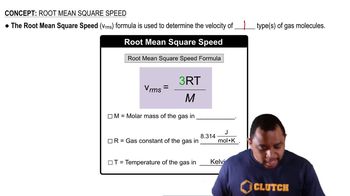
Root Mean Square Speed Formula
Average Speed
The average speed of gas particles is calculated by taking the total distance traveled by all particles divided by the total time taken. It is a straightforward arithmetic mean and typically falls between the most probable speed and the root-mean-square speed, reflecting the overall motion of the gas.
Video consigliato:
Percorso guidato
Average Bond Order
Pratica correlata
Domanda del libro di testo
688
views
1
rank
Domanda del libro di testo
Consider the following graph. (b) If A and B refer to the same gas at two different temperatures, which represents the higher temperature?
334
views
Domanda del libro di testo
Consider the following samples of gases:
If the three samples are all at the same temperature, rank them with respect to (c) density
431
views
Domanda del libro di testo
Consider the following samples of gases:
If the three samples are all at the same temperature, rank them with respect to (a) total pressure
783
views
Domanda del libro di testo
Consider the following graph. (a) If curves A and B refer to two different gases, He and O2, at the same temperature, which curve corresponds to He?
599
views
