

The adult blue whale has a lung capacity of 5.0×10³ L. Calculate the mass of air (assume an average molar mass of 28.98 g/mol) contained in an adult blue whale’s lungs at 0.0°C and 1.00 atm, assuming the air behaves ideally.
Ch.10 - Gases

Brown15th EditionChemistry: The Central ScienceISBN: 9780137542970Non è quello che usi tu?Cambia libro di testo
Capitolo 10, Problema 38a
If the pressure exerted by ozone, O3, in the stratosphere is 3.0×10⁻³atm and the temperature is 250 K, how many ozone molecules are in a liter?
Guida verificata passo dopo passo1
Identify the given values: Pressure (P) = 3.0×10⁻³ atm, Temperature (T) = 250 K, and Volume (V) = 1 L.
Use the ideal gas law equation, PV = nRT, where P is the pressure, V is the volume, n is the number of moles, R is the gas constant (0.0821 L atm K−1 mol−1), and T is the temperature.
Rearrange the ideal gas law equation to solve for n (number of moles of gas): n = \(\frac{PV}{RT}\).
Calculate the number of moles of ozone using the values of P, V, R, and T substituted into the rearranged ideal gas law equation.
Convert the number of moles of ozone to number of molecules by using Avogadro's number (6.022×10^23 molecules/mol). Multiply the number of moles by Avogadro's number to find the total number of ozone molecules in 1 liter.

Risposta video verificata per un problema simile:
Questa soluzione video è stata consigliata dai nostri tutor come utile per risolvere questo problema.
Durata del video:
5mConcetti chiave
Ecco i concetti essenziali che devi comprendere per rispondere correttamente alla domanda.
Ideal Gas Law
The Ideal Gas Law relates the pressure, volume, temperature, and number of moles of a gas through the equation PV = nRT. In this context, P is the pressure of ozone, V is the volume (1 liter), n is the number of moles, R is the ideal gas constant, and T is the temperature in Kelvin. This law allows us to calculate the number of molecules present in a given volume of gas under specific conditions.
Video consigliato:
Percorso guidato
Ideal Gas Law Formula
Avogadro's Number
Avogadro's Number, approximately 6.022 × 10²³, is the number of particles (atoms, molecules, etc.) in one mole of a substance. This concept is crucial for converting between moles and molecules. Once we determine the number of moles of ozone using the Ideal Gas Law, we can multiply by Avogadro's Number to find the total number of ozone molecules in the specified volume.
Video consigliato:
Percorso guidato
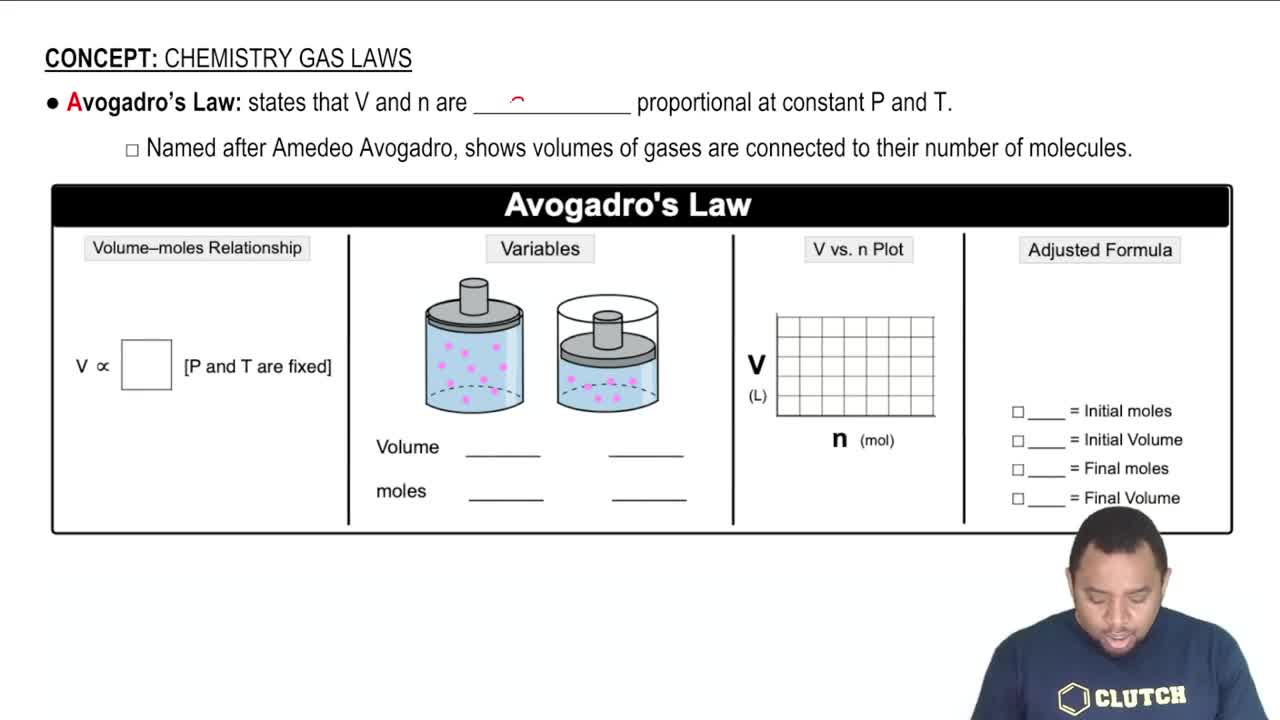
Avogadro's Law
Gas Pressure and Temperature Relationship
Gas pressure is influenced by temperature, as described by the kinetic molecular theory. Higher temperatures increase the kinetic energy of gas molecules, leading to higher pressure if the volume is constant. In this problem, understanding how pressure and temperature interact is essential for applying the Ideal Gas Law correctly to find the number of ozone molecules at the given conditions.
Video consigliato:
Percorso guidato
Standard Temperature and Pressure
Pratica correlata
Domanda del libro di testo
An aerosol spray can with a volume of 250 mL contains 2.30 g of propane gas (C3H8) as a propellant. a. If the can is at 23°C, what is the pressure in the can?
Domanda del libro di testo
A scuba diver’s tank contains 0.29 kg of O2 compressed into a volume of 2.3 L. b. What volume would this oxygen occupy at 26°C and 0.95 atm?
Domanda del libro di testo
Carbon dioxide makes up approximately 0.04% of Earth’s atmosphere. If you collect a 2.0-L sample from the atmosphere at sea level (1.00 atm) on a warm day (27°C), how many CO2 molecules are in your sample?
Domanda del libro di testo
Calculate the number of molecules in a deep breath of air whose volume is 2.25 L at body temperature, 37°C, and a pressure of 735 torr.
