

Ch.10 - Gases
Brown - Chemistry: The Central Science 15th Edition
Brown15th EditionChemistry: The Central ScienceISBN: 9780137542970Non è quello che usi tu?Cambia libro di testo
Capitolo 10, Problema 19d

The typical atmospheric pressure on top of Mount Everest (29,032 ft) is about 265 torr. Convert this pressure to d. bars,

Guida verificata passo dopo passo
1
Understand the units involved: 1 bar is equivalent to 1000 millibars (mbar) and 1 bar is approximately equal to 750.06 torr.
Set up the conversion factor from torr to bar. Since 1 bar = 750.06 torr, the conversion factor is 1 bar / 750.06 torr.
Multiply the given pressure in torr (265 torr) by the conversion factor to convert it to bars: (265 torr) * (1 bar / 750.06 torr).
Simplify the expression by canceling out the torr units, leaving you with the pressure in bars.
Perform the division to find the pressure in bars, ensuring to keep track of significant figures based on the given data.

Risposta video verificata per un problema simile:

Questa soluzione video è stata consigliata dai nostri tutor come utile per risolvere questo problema.
Durata del video:
1m

Concetti chiave

Ecco i concetti essenziali che devi comprendere per rispondere correttamente alla domanda.

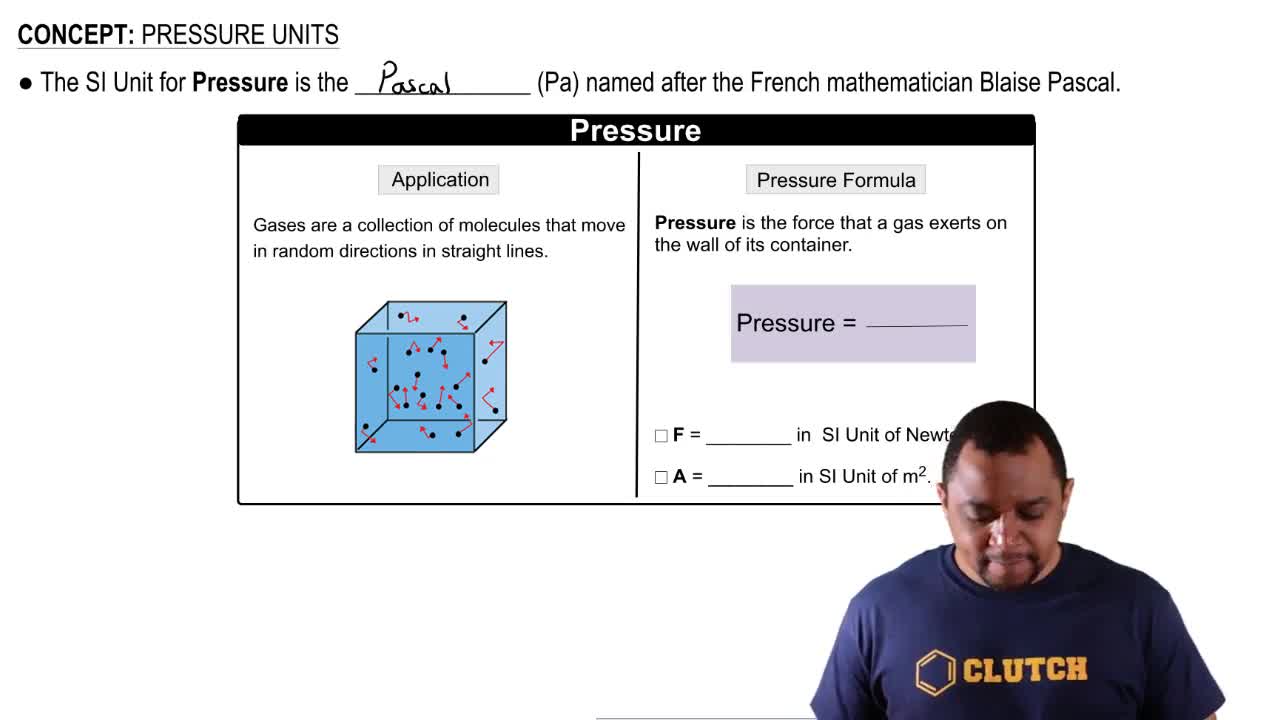
Pressure Units

Pressure is a measure of the force exerted per unit area. Common units for pressure include torr, pascal, and bar. Understanding how to convert between these units is essential for solving problems related to atmospheric pressure, as different contexts may require different units.
Video consigliato:

Conversion Factors

Conversion factors are ratios used to convert a quantity from one unit to another. For pressure, knowing the relationship between torr and d. bars is crucial. Specifically, 1 d. bar is equivalent to 1000 millibar, and 1 torr is approximately 1.33322 millibar, which allows for accurate conversions between these units.
Video consigliato:
Percorso guidato
01:56
Conversion Factors

Atmospheric Pressure

Atmospheric pressure is the pressure exerted by the weight of the atmosphere above a given point. It varies with altitude; for example, at higher elevations like Mount Everest, the atmospheric pressure is significantly lower than at sea level. Understanding this concept helps contextualize the pressure values being converted.
Video consigliato:
Percorso guidato
02:09
Total Pressure Example