Ch.10 - Gases
Brown - Chemistry: The Central Science 15th Edition
Brown15th EditionChemistry: The Central ScienceISBN: 9780137542970Non è quello che usi tu?Cambia libro di testo
Capitolo 10, Problema 83

Which one or more of the following statements are true? (a) O2 will effuse faster than Cl2. (b) Effusion and diffusion are different names for the same process. (c) Perfume molecules travel to your nose by the process of effusion. (d) The higher the density of a gas, the shorter the mean free path.

Guida verificata passo dopo passo
1
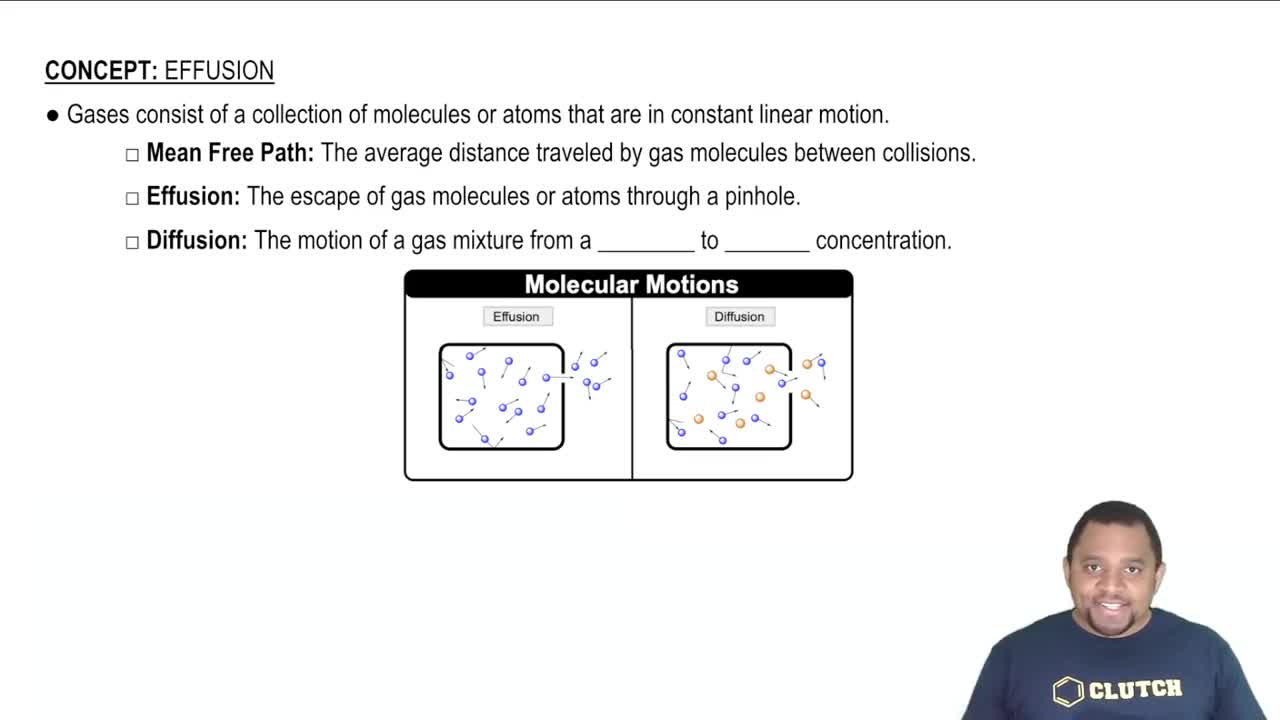
Identify the concept of effusion and diffusion: Effusion is the process by which gas molecules escape through a tiny hole into a vacuum, while diffusion is the spreading of gas molecules throughout a container or space.
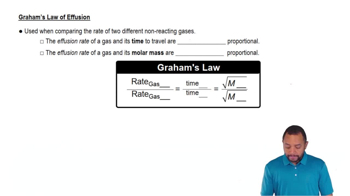
Apply Graham's Law of Effusion to statement (a): According to Graham's Law, the rate of effusion of a gas is inversely proportional to the square root of its molar mass. Compare the molar masses of O2 and Cl2 to determine which effuses faster.
Evaluate statement (b) by clarifying the difference between effusion and diffusion: Effusion involves gas molecules passing through a small opening, while diffusion involves the mixing of gases in a space.
Consider statement (c) by understanding how perfume molecules travel: Perfume molecules spread through the air by diffusion, not effusion, as they mix with air molecules and travel to your nose.
Analyze statement (d) by considering the relationship between gas density and mean free path: The mean free path is the average distance a molecule travels before colliding with another molecule. Higher density means more molecules in a given volume, leading to a shorter mean free path.

Risposta video verificata per un problema simile:

Questa soluzione video è stata consigliata dai nostri tutor come utile per risolvere questo problema.
Durata del video:
4m

Concetti chiave

Ecco i concetti essenziali che devi comprendere per rispondere correttamente alla domanda.

Graham's Law of Effusion

Graham's Law states that the rate of effusion of a gas is inversely proportional to the square root of its molar mass. This means lighter gases effuse faster than heavier gases. For example, O2 (molar mass ~32 g/mol) will effuse faster than Cl2 (molar mass ~71 g/mol) because it is lighter.
Video consigliato:
Percorso guidato
2:03
Graham's Law of Effusion

Diffusion vs. Effusion

Diffusion is the process by which gas molecules spread out to occupy a space uniformly, while effusion is the escape of gas molecules through a tiny opening into a vacuum. Although both processes involve the movement of gas particles, they are distinct in their mechanisms and conditions.
Video consigliato:
Percorso guidato
02:33
Effusion vs Diffusion

Mean Free Path

The mean free path is the average distance a gas molecule travels between collisions with other molecules. It is inversely related to the density of the gas; as density increases, the mean free path decreases due to more frequent collisions. Thus, higher density gases have shorter mean free paths.
Video consigliato:
Percorso guidato
01:05
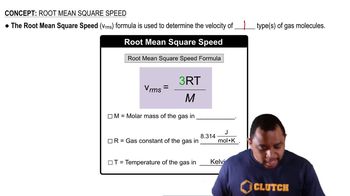
Root Mean Square Speed Formula
Pratica correlata
Domanda del libro di testo

(c) Calculate the most probable speeds of Cl2 molecules at 300 K.

131
views

Domanda del libro di testo

Hydrogen has two naturally occurring isotopes, 1H and 2H. Chlorine also has two naturally occurring isotopes, 35Cl and 37Cl. Thus, hydrogen chloride gas consists of four distinct types of molecules: 1H35Cl, 1H37Cl, 2H35Cl, and 2H37Cl. Place these four molecules in order of increasing rate of effusion.

1412
views
Domanda del libro di testo

At constant pressure, the mean free path 1l2 of a gas molecule is directly proportional to temperature. At constant temperature, l is inversely proportional to pressure. If you compare two different gas molecules at the same temperature and pressure, l is inversely proportional to the square of the diameter of the gas molecules. Put these facts together to create a formula for the mean free path of a gas molecule with a proportionality constant (call it Rmfp, like the ideal-gas constant) and define units for Rmfp.

951
views
Domanda del libro di testo

(c) Calculate the most probable speed of an ozone molecule in the stratosphere, where the temperature is 270 K.

521
views
Domanda del libro di testo

(c) Calculate the most probable speeds of CO molecules at 300 K.

123
views
Domanda del libro di testo

Arsenic(III) sulfide sublimes readily, even below its melting point of 320 °C. The molecules of the vapor phase are found to effuse through a tiny hole at 0.52 times the rate of effusion of Xe atoms under the same conditions of temperature and pressure. What is the molecular formula of arsenic(III) sulfide in the gas phase?

1628
views