Ch.10 - Gases
Brown - Chemistry: The Central Science 15th Edition
Brown15th EditionChemistry: The Central ScienceISBN: 9780137542970Non è quello che usi tu?Cambia libro di testo
Capitolo 10, Problema 106

You have a sample of gas at −33°C. You wish to increase the rms speed by a factor of 2. To what temperature should the gas be heated?

Guida verificata passo dopo passo
1
insert step 1> Convert the initial temperature from Celsius to Kelvin using the formula: T(K) = T(°C) + 273.15.
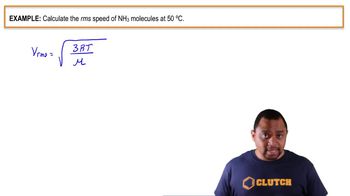
insert step 2> Recall the formula for the root mean square (rms) speed of a gas: v_{rms} = \(\sqrt{\frac{3kT}{m}\)}, where k is the Boltzmann constant, T is the temperature in Kelvin, and m is the mass of a gas molecule.
insert step 3> Since you want to increase the rms speed by a factor of 2, set up the equation: 2v_{rms, initial} = v_{rms, final}.
insert step 4> Substitute the rms speed formula into the equation: 2\(\sqrt{\frac{3kT_{initial}\)}{m}} = \(\sqrt{\frac{3kT_{final}\)}{m}}.
insert step 5> Solve for T_{final} by squaring both sides and isolating T_{final}: T_{final} = 4T_{initial}.

Risposta video verificata per un problema simile:

Questa soluzione video è stata consigliata dai nostri tutor come utile per risolvere questo problema.
Durata del video:
2m

Concetti chiave

Ecco i concetti essenziali che devi comprendere per rispondere correttamente alla domanda.

RMS Speed of Gas

The root mean square (RMS) speed of gas molecules is a measure of the average speed of particles in a gas. It is directly related to the temperature of the gas, as higher temperatures result in greater kinetic energy and thus higher speeds. The formula for RMS speed is v_rms = √(3kT/m), where k is the Boltzmann constant, T is the temperature in Kelvin, and m is the mass of a gas particle.
Video consigliato:
Percorso guidato
02:57
RMS Speed Example

Temperature and Kinetic Energy

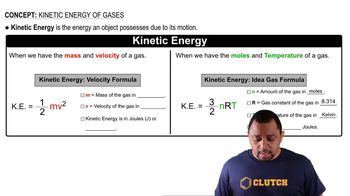
Temperature is a measure of the average kinetic energy of the particles in a substance. In gases, as temperature increases, the kinetic energy of the molecules also increases, leading to higher speeds. This relationship is crucial for understanding how changes in temperature affect the motion of gas particles and their RMS speed.
Video consigliato:
Percorso guidato
02:27
Kinetic Energy Formulas

Absolute Temperature Scale

The absolute temperature scale, measured in Kelvin (K), is essential for calculations in thermodynamics and gas laws. To convert Celsius to Kelvin, you add 273.15. Since the RMS speed is dependent on temperature in Kelvin, it is important to use this scale when determining the new temperature required to achieve a specific change in speed.
Video consigliato:
Pratica correlata
Domanda del libro di testo

Consider the following gases, all at STP: Ne, SF6, N2, CH4. (d) Which one has the highest total molecular volume relative to the space occupied by the gas?

626
views

Domanda del libro di testo

Consider the following gases, all at STP: Ne, SF6, N2, CH4. (a) Which gas is most likely to depart from the assumption of the kinetic-molecular theory that says there are no attractive or repulsive forces between molecules?

1083
views
Domanda del libro di testo

Assume that an exhaled breath of air consists of 74.8% N2, 15.3% O2, 3.7% CO2, and 6.2% water vapor. (c) How many grams of glucose (C6H12O6) would need to be metabolized to produce this quantity of CO2? (The chemical reaction is the same as that for combustion of C6H12O6. See Section 3.2 and Problem 10.57.)

518
views
Domanda del libro di testo

An ideal gas at a pressure of 1.50 atm is contained in a bulb of unknown volume. A stopcock is used to connect this bulb with a previously evacuated bulb that has a volume of 0.800 L as shown here. When the stopcock is opened, the gas expands into the empty bulb. If the temperature is held constant during this process and the final pressure is 695 torr, what is the volume of the bulb that was originally filled with gas?

Domanda del libro di testo

Consider the following gases, all at STP: Ne, SF6, N2, CH4. (f) Which one would effuse more rapidly than N2?

472
views
Domanda del libro di testo

A 1.42-g sample of helium and an unknown mass of O2 are mixed in a flask at room temperature. The partial pressure of the helium is 42.5 torr, and that of the oxygen is 158 torr. What is the mass of the oxygen?

1
views