Ch.11 - Liquids and Intermolecular Forces
Brown - Chemistry: The Central Science 15th Edition
Brown15th EditionChemistry: The Central ScienceISBN: 9780137542970Non è quello che usi tu?Cambia libro di testo
Capitolo 11, Problema 53

(a) Place the following substances in order of increasing volatility: CH4, CBr4, CH2Cl2, CH3Cl, CHBr3, and CH2Br2. (b) How do the boiling points vary through this series? (c) Explain your answer to part (b) in terms of intermolecular forces.

Guida verificata passo dopo passo
1
Identify the types of intermolecular forces present in each substance: CH_4, CBr_4, CH_2Cl_2, CH_3Cl, CHBr_3, and CH_2Br_2. Consider London dispersion forces, dipole-dipole interactions, and hydrogen bonding.
Recognize that volatility is inversely related to the strength of intermolecular forces. Substances with weaker intermolecular forces are more volatile.
Arrange the substances in order of increasing volatility by comparing the strength of their intermolecular forces. Consider molecular weight and polarity.
For boiling points, note that they are directly related to the strength of intermolecular forces. Substances with stronger intermolecular forces have higher boiling points.
Explain the variation in boiling points by discussing the role of molecular weight and polarity in determining the strength of London dispersion forces and dipole-dipole interactions.

Risposta video verificata per un problema simile:

Questa soluzione video è stata consigliata dai nostri tutor come utile per risolvere questo problema.
Durata del video:
2m

Concetti chiave

Ecco i concetti essenziali che devi comprendere per rispondere correttamente alla domanda.

Volatility

Volatility refers to the tendency of a substance to vaporize. It is influenced by the strength of intermolecular forces; substances with weaker forces tend to be more volatile. For example, lighter molecules with weaker London dispersion forces will evaporate more readily than heavier molecules with stronger dipole-dipole interactions or hydrogen bonds.
Video consigliato:
Percorso guidato
02:50
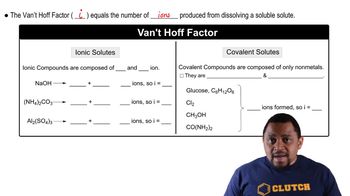
Van't Hoff Factor

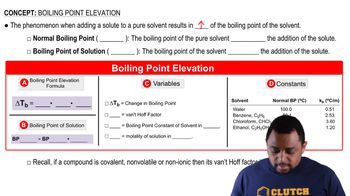
Boiling Point

The boiling point of a substance is the temperature at which its vapor pressure equals the external pressure, allowing it to transition from liquid to gas. Generally, higher boiling points indicate stronger intermolecular forces. In the context of the given substances, as molecular weight and polarity increase, boiling points typically rise due to enhanced van der Waals forces.
Video consigliato:
Percorso guidato
03:05
Boiling Point Elevation

Intermolecular Forces

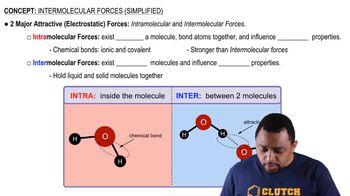
Intermolecular forces are the forces of attraction or repulsion between molecules. They include London dispersion forces, dipole-dipole interactions, and hydrogen bonds. The type and strength of these forces significantly affect both volatility and boiling points; for instance, substances with stronger intermolecular forces will have lower volatility and higher boiling points compared to those with weaker forces.
Video consigliato:
Percorso guidato
01:59
Intermolecular vs Intramolecular Forces
Pratica correlata
Domanda del libro di testo

(a) Two pans of water are on different burners of a stove. One pan of water is boiling vigorously, while the other is boiling gently. What can be said about the temperature of the water in the two pans?

663
views

Domanda del libro di testo

You are high up in the mountains and boil water to make some tea. However, when you drink your tea, it is not as hot as it should be. You try again and again, but the water is just not hot enough to make a hot cup of tea. Which is the best explanation for this result? (a) High in the mountains, it is probably very dry, and so the water is rapidly evaporating from your cup and cooling it. (b) High in the mountains, it is probably very windy, and so the water is rapidly evaporating from your cup and cooling it. (c) High in the mountains, the air pressure is significantly less than 1 atm, so the boiling point of water is much lower than at sea level. (d) High in the mountains, the air pressure is significantly less than 1 atm, so the boiling point of water is much higher than at sea level.

1034
views
Domanda del libro di testo

The critical temperatures and pressures of a series of halogenated methanes are as follows: (c) Predict the critical temperature and pressure for CCl4 based on the trends in this table. Look up the experimentally determined critical temperatures and pressures for CCl4, using a source such as the CRC Handbook of Chemistry and Physics, and suggest a reason for any discrepancies.

459
views
Domanda del libro di testo

The critical temperatures and pressures of a series of halogenated methanes are as follows:

(a) List the intermolecular forces that occur for each compound.

346
views