Ch.11 - Liquids and Intermolecular Forces
Brown - Chemistry: The Central Science 15th Edition
Brown15th EditionChemistry: The Central ScienceISBN: 9780137542970Non è quello che usi tu?Cambia libro di testo
Capitolo 11, Problema 2

(a) Which kind of intermolecular attractive force is shown in each case here? (b) Predict which of the four interactions is the weakest. [Section 11.2]

Guida verificata passo dopo passo
1
Identify the types of intermolecular forces: London dispersion forces, dipole-dipole interactions, hydrogen bonding, and ion-dipole interactions.
Determine the molecular characteristics of each case to identify the type of intermolecular force present.
For each case, check if the molecules are nonpolar (London dispersion), polar (dipole-dipole), have hydrogen bonded to N, O, or F (hydrogen bonding), or involve ions (ion-dipole).
Compare the strength of the identified intermolecular forces: London dispersion forces are generally the weakest, followed by dipole-dipole interactions, hydrogen bonding, and ion-dipole interactions.
Predict which interaction is the weakest based on the identified intermolecular forces in each case.

Risposta video verificata per un problema simile:

Questa soluzione video è stata consigliata dai nostri tutor come utile per risolvere questo problema.
Durata del video:
1m

Concetti chiave

Ecco i concetti essenziali che devi comprendere per rispondere correttamente alla domanda.

Intermolecular Forces

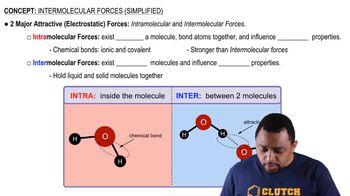
Intermolecular forces are the attractive forces between molecules that influence physical properties such as boiling and melting points. The main types include hydrogen bonding, dipole-dipole interactions, and London dispersion forces. Understanding these forces is crucial for predicting how substances will behave in different states and conditions.
Video consigliato:
Percorso guidato
01:59
Intermolecular vs Intramolecular Forces

Hydrogen Bonding

Hydrogen bonding is a specific type of strong dipole-dipole interaction that occurs when hydrogen is covalently bonded to highly electronegative atoms like nitrogen, oxygen, or fluorine. This interaction significantly affects the properties of substances, such as water's high boiling point compared to other similar-sized molecules, making it essential for understanding molecular behavior.
Video consigliato:
Percorso guidato
01:22
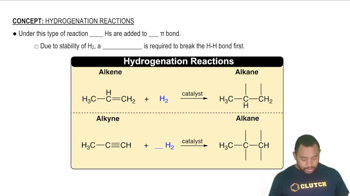
Hydrogenation Reactions

Strength of Intermolecular Forces

The strength of intermolecular forces varies among the different types, with hydrogen bonds being the strongest, followed by dipole-dipole interactions, and then London dispersion forces, which are the weakest. Recognizing this hierarchy is important for predicting the physical properties of substances, such as solubility and volatility.
Video consigliato:
Percorso guidato
01:59
Intermolecular vs Intramolecular Forces