
Ch.11 - Liquids and Intermolecular Forces
Brown - Chemistry: The Central Science 15th Edition
Brown15th EditionChemistry: The Central ScienceISBN: 9780137542970Non è quello che usi tu?Cambia libro di testo
Capitolo 11, Problema 15d

At standard temperature and pressure, the molar volumes of Cl2 and NH3 gases are 22.06 and 22.40 L, respectively. (d) Are the molar volumes in the solid state as similar as they are in the gaseous state?

Guida verificata passo dopo passo
1
Understand that the molar volume of a gas at standard temperature and pressure (STP) is approximately 22.4 L/mol, which is close to the given values for Cl2 and NH3 gases.
Recognize that gases have similar molar volumes at STP due to the ideal gas law, which states that one mole of any ideal gas occupies the same volume under the same conditions of temperature and pressure.
Consider the properties of solids: In the solid state, molecules are closely packed, and the molar volume is determined by the size and arrangement of the molecules, which can vary significantly between different substances.
Acknowledge that Cl2 and NH3 have different molecular structures and intermolecular forces, leading to different packing efficiencies and molar volumes in the solid state.
Conclude that the molar volumes of Cl2 and NH3 in the solid state are likely to be less similar than in the gaseous state due to differences in molecular structure and intermolecular interactions.

Risposta video verificata per un problema simile:

Questa soluzione video è stata consigliata dai nostri tutor come utile per risolvere questo problema.
Durata del video:
2m

Concetti chiave

Ecco i concetti essenziali che devi comprendere per rispondere correttamente alla domanda.

Molar Volume

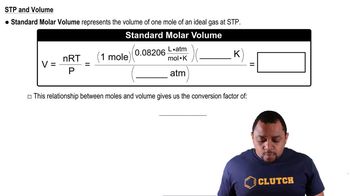
Molar volume is the volume occupied by one mole of a substance at a given temperature and pressure, typically measured in liters per mole (L/mol). At standard temperature and pressure (STP), the molar volume of an ideal gas is approximately 22.4 L/mol. This concept is crucial for comparing the behavior of gases and understanding how their volumes change under different states of matter.
Video consigliato:
Percorso guidato
01:21
Standard Molar Volume

States of Matter

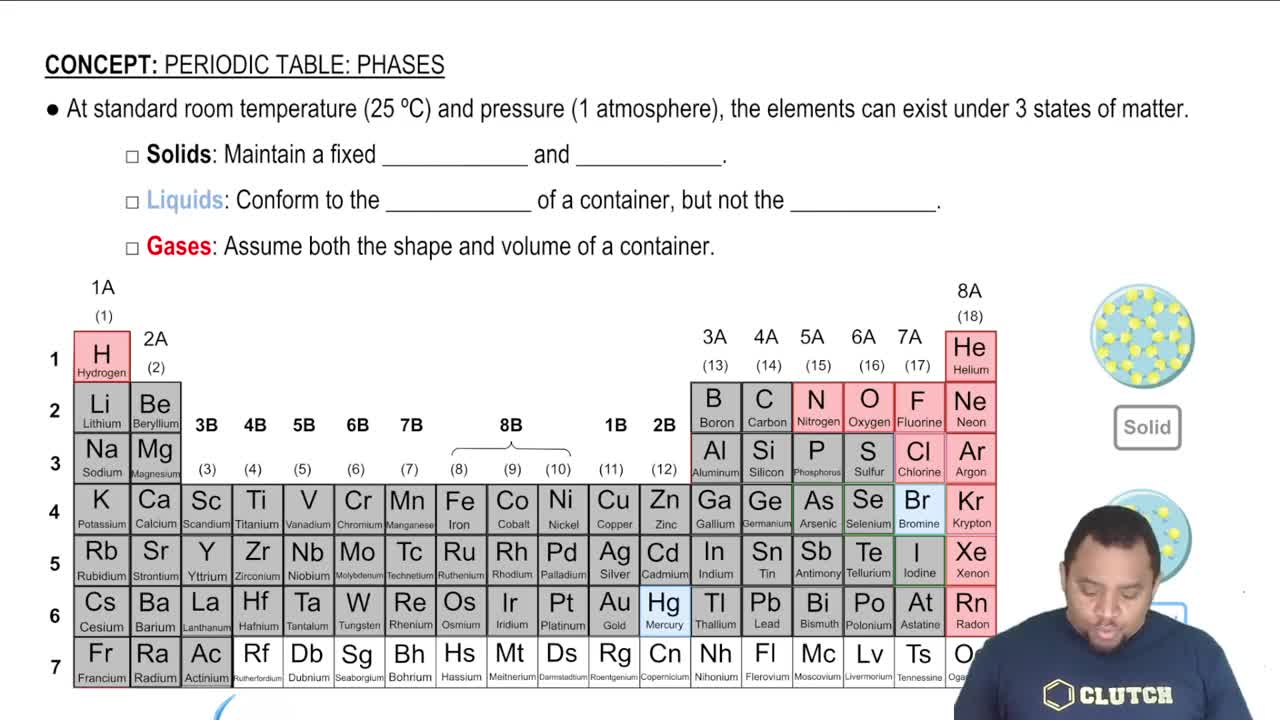
Matter exists in different states, primarily solid, liquid, and gas, each with distinct properties. In solids, particles are closely packed and vibrate in fixed positions, leading to a much lower molar volume compared to gases, where particles are far apart and move freely. Understanding these states helps in analyzing how substances behave under varying conditions, such as temperature and pressure.
Video consigliato:
Percorso guidato
03:25
Element States of Matter

Comparative Analysis of Gases and Solids

When comparing the molar volumes of gases and solids, it is essential to recognize that gases typically have much larger molar volumes due to the significant space between particles. In contrast, solids have tightly packed particles, resulting in much smaller molar volumes. This difference highlights the impact of intermolecular forces and particle arrangement on the physical properties of substances in different states.
Video consigliato:
Percorso guidato
06:11
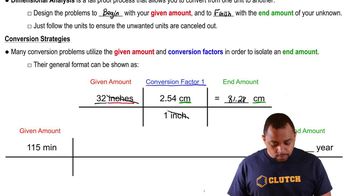
Dimensional Analysis