Ch.11 - Liquids and Intermolecular Forces
Brown - Chemistry: The Central Science 15th Edition
Brown15th EditionChemistry: The Central ScienceISBN: 9780137542970Non è quello che usi tu?Cambia libro di testo
Capitolo 11, Problema 8b

The molecules
have the same molecular formula (C3H8O) but different chemical structures. (b) Which molecule do you expect to have a larger dipole moment? [Sections 11.2 and 11.5]

Guida verificata passo dopo passo
1
Step 1: Identify the molecules. The molecular formula C3H8O could represent several different molecules, such as propanol or methoxyethane. The structure of these molecules will determine their polarity and thus their dipole moment.
Step 2: Draw the Lewis structures of the molecules. This will help you visualize the distribution of electrons in the molecule and identify any polar bonds.
Step 3: Determine the polarity of the molecules. A molecule is polar if it has polar bonds and is not symmetrical. A polar molecule will have a larger dipole moment than a nonpolar molecule.
Step 4: Compare the dipole moments. The molecule with the more polar bonds and less symmetry will have the larger dipole moment.
Step 5: Remember that the dipole moment is a vector quantity. It depends not only on the magnitude of the individual bond dipoles but also on their direction. If the bond dipoles do not cancel each other out, the molecule will have a net dipole moment.

Risposta video verificata per un problema simile:

Questa soluzione video è stata consigliata dai nostri tutor come utile per risolvere questo problema.
Durata del video:
2m

Concetti chiave

Ecco i concetti essenziali che devi comprendere per rispondere correttamente alla domanda.

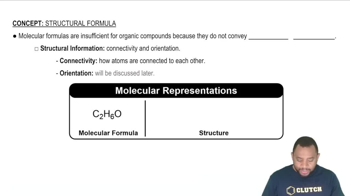
Molecular Formula vs. Structural Isomers

Molecular formulas represent the types and numbers of atoms in a molecule, but they do not convey how those atoms are arranged. Structural isomers are compounds that share the same molecular formula but differ in the connectivity of their atoms, leading to different chemical and physical properties. Understanding this distinction is crucial for analyzing how structural differences can affect molecular behavior.
Video consigliato:
Percorso guidato
02:08
Molecular Formula

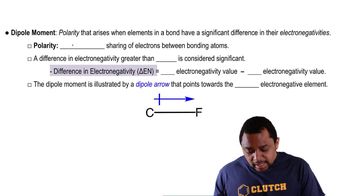
Dipole Moment

The dipole moment is a measure of the separation of positive and negative charges in a molecule, indicating its polarity. It is influenced by the molecular geometry and the electronegativity of the atoms involved. Molecules with significant differences in electronegativity between bonded atoms and asymmetrical shapes typically exhibit larger dipole moments, making this concept essential for predicting molecular interactions.
Video consigliato:

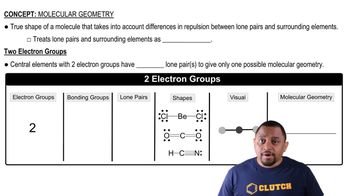
Electronegativity and Molecular Geometry

Electronegativity refers to the ability of an atom to attract electrons in a bond, which affects the distribution of electron density in a molecule. The geometry of a molecule, determined by the arrangement of its atoms, influences how these charges are distributed. Together, electronegativity and geometry help predict the overall dipole moment, as asymmetrical arrangements of polar bonds can lead to a net dipole.
Video consigliato:
Percorso guidato
01:33
Molecular Geometry with Two Electron Groups
Pratica correlata
Domanda del libro di testo

a. Which of the molecules shown here can form dipole–dipole interactions with other molecules of the same type?

b. Which are capable of forming hydrogen bonds with other molecules of the same type? [Section 11.2]

Domanda del libro di testo

The phase diagram of a hypothetical substance is

(b) What is the physical state of the substance under the following conditions? (i) T = 150 K, P = 0.2 atm; (ii) T = 100 K, P = 0.8 atm; (iii) T = 300K, P = 1.0atm. [Section 11.6]

978
views
Domanda del libro di testo

Using this graph of CS2 data, determine (a) the approximate vapor pressure of CS2 at 30°C,

589
views
1
rank
Domanda del libro di testo

If 42.0 kJ of heat is added to a 32.0-g sample of liquid meth-ane under 1 atm of pressure at a temperature of -170°C, what are the final state and temperature of the methane once the system equilibrates? Assume no heat is lost to the surroundings. The normal boiling point of methane is -161.5 °C. The specific heats of liquid and gaseous methane are 3.48 and 2.22 J/g-K, respectively. [Section 11.4]

3
views
Domanda del libro di testo

At three different temperatures, T1, T2, and T3, the molecules in a liquid crystal align in these ways:

(a) At which temperature or temperatures is the substance in a liquid crystalline state? At those temperatures, which type of liquid crystalline phase is depicted?

595
views
1
rank
Domanda del libro di testo

At three different temperatures, T1, T2, and T3, the molecules in a liquid crystal align in these ways:

(b) Which is the highest of these three temperatures? [Section 11.7]

296
views