
Ch.11 - Liquids and Intermolecular Forces
Brown - Chemistry: The Central Science 15th Edition
Brown15th EditionChemistry: The Central ScienceISBN: 9780137542970Non è quello che usi tu?Cambia libro di testo
Capitolo 11, Problema 76b

The table below lists the density of O2 at various temperatures and at 1 atm. The normal melting point of O2 is 54 K.
(b) Over what temperature range is O2 a liquid?

Guida verificata passo dopo passo
1
Determine the phase change temperatures for O_2. The normal melting point is given as 54 K, which is the temperature at which O_2 transitions from solid to liquid.
Identify the boiling point of O_2 at 1 atm. This is the temperature at which O_2 transitions from liquid to gas. You may need to look up this value if it's not provided in the problem.
Understand that O_2 will be in the liquid phase between its melting point and boiling point.
Express the temperature range for the liquid phase of O_2 as the interval between the melting point and boiling point.
Conclude that O_2 is a liquid between the melting point (54 K) and the boiling point (which you need to find).

Risposta video verificata per un problema simile:

Questa soluzione video è stata consigliata dai nostri tutor come utile per risolvere questo problema.
Durata del video:
1m

Concetti chiave

Ecco i concetti essenziali che devi comprendere per rispondere correttamente alla domanda.

Phase Changes

Phase changes refer to the transitions between solid, liquid, and gas states of matter. For oxygen (O2), understanding these changes is crucial, particularly the melting point and boiling point, which define the temperature ranges where the substance exists as a solid, liquid, or gas. The melting point indicates the temperature at which O2 transitions from solid to liquid, while the boiling point marks the change from liquid to gas.
Video consigliato:
Percorso guidato
01:46
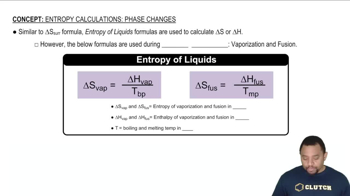
Entropy in Phase Changes

Density and Temperature Relationship

Density is defined as mass per unit volume and can vary with temperature. For gases like O2, density decreases as temperature increases, due to the increased kinetic energy of the molecules causing them to occupy more space. This relationship is important for determining the state of a substance at different temperatures, particularly when assessing whether O2 is in a liquid state at specific temperatures.
Video consigliato:
Percorso guidato
03:48
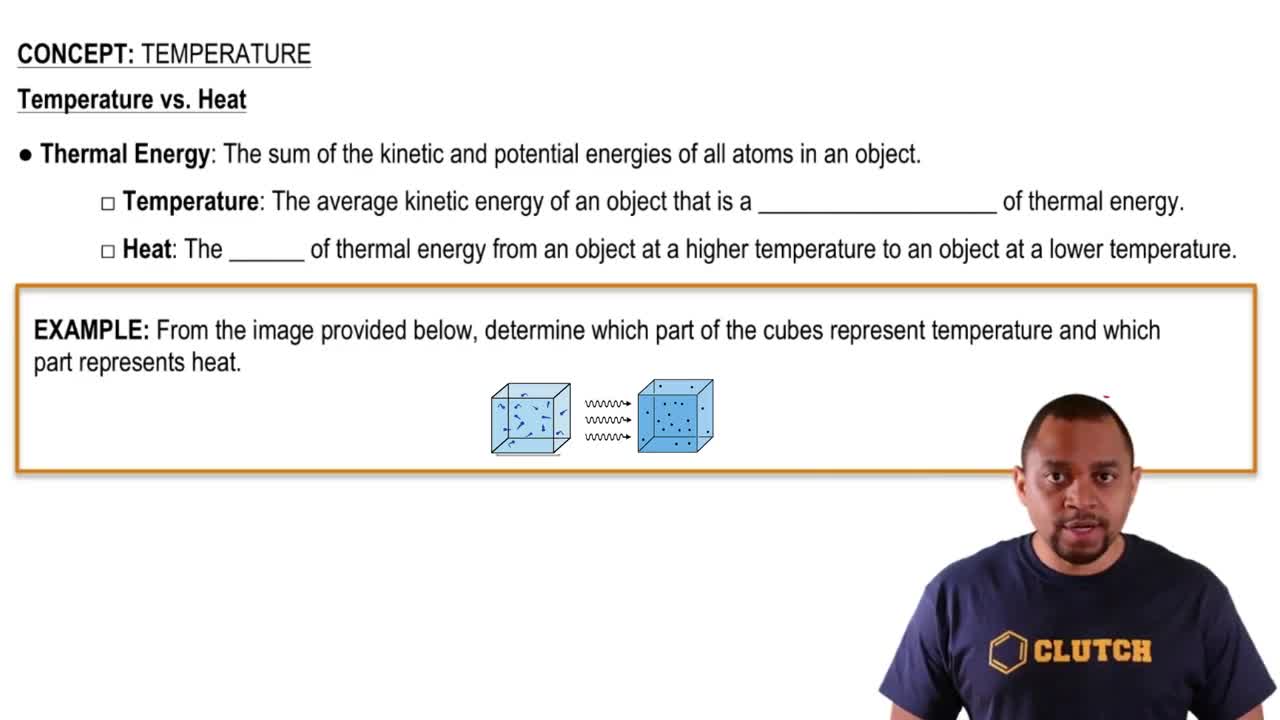
Temperature vs Heat

Critical Point

The critical point of a substance is the temperature and pressure at which the distinction between liquid and gas phases disappears. For O2, knowing the critical temperature helps in understanding the conditions under which it can exist as a liquid. If the temperature is below the critical temperature and above the melting point, O2 can exist as a liquid, which is essential for answering the question about its liquid state.
Video consigliato:
Percorso guidato
03:05
Boiling Point Elevation
Pratica correlata
Domanda del libro di testo

Suppose you have two colorless molecular liquids, one boiling at - 84 °C, the other at 34 °C, and both at atmospheric 6 pressure. Which of the following statements is correct? For each statement that is not correct, modify the statement so that it is correct. (e) At - 84 °C both liquids have vapor pressures of 760 mm Hg.

478
views
Domanda del libro di testo

Suppose you have two colorless molecular liquids, one boiling at −84°C, the other at 34°C, and both at atmospheric pressure. Which of the following statements are true? d. The two liquids have identical vapor pressures at their normal boiling points.

Domanda del libro di testo

Two isomers of the planar compound 1,2-dichloroethylene are shown here.

(a) Which of the two isomers will have the stronger dipole– dipole forces?

585
views
Domanda del libro di testo

As the intermolecular attractive forces between molecules increase in magnitude, do you expect each of the following to increase or decrease in magnitude? (g) critical temperature.

669
views
Domanda del libro di testo

In all four liquid crystalline phases shown in Figure 11.32, the long axis of the molecule preferentially orders along one or more specific directions. In three of the four phases the molecules also lose some freedom of translational motion. In which of the four liquid crystalline phases do the molecules retain the freedom to move in all three directions that they possess in the liquid phase: nematic, smectic A, smectic C, or cholesteric?