
Ch.12 - Solids and Modern Materials
Brown - Chemistry: The Central Science 15th Edition
Brown15th EditionChemistry: The Central ScienceISBN: 9780137542970Non è quello che usi tu?Cambia libro di testo
Capitolo 12, Problema 63a

CuI, CsI, and NaI each adopt a different type of structure. The three different structures to consider are those shown in Figure 12.25 for CsCl, NaCl, and ZnS. a. Use ionic radii, Cs+(𝑟=1.81 Å), Na+(𝑟=1.16 Å), Cu+(𝑟=0.74 Å), and, I−(𝑟=2.06 Å), to predict which compound will crystallize with which structure.

Guida verificata passo dopo passo
1
Identify the three structures: CsCl, NaCl, and ZnS, and understand their coordination numbers and geometries.
Calculate the radius ratio (cation radius/anion radius) for each compound: CuI, CsI, and NaI.
Compare the calculated radius ratios to the typical radius ratio ranges for each structure type: CsCl (0.732-1.0), NaCl (0.414-0.732), and ZnS (0.225-0.414).
Assign each compound to the structure type that matches its radius ratio.
Verify the assignments by considering the coordination numbers and the stability of the resulting structures.

Risposta video verificata per un problema simile:

Questa soluzione video è stata consigliata dai nostri tutor come utile per risolvere questo problema.
Durata del video:
3m

Concetti chiave

Ecco i concetti essenziali che devi comprendere per rispondere correttamente alla domanda.

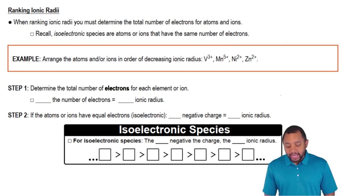
Ionic Radii

Ionic radii refer to the effective size of an ion in a crystal lattice, which influences how ions pack together in a solid structure. The size of the cation and anion affects the stability and type of crystal lattice formed. Larger anions can accommodate smaller cations, while the ratio of their sizes can help predict the type of structure, such as cubic or hexagonal.
Video consigliato:
Percorso guidato
03:56
Ranking Ionic Radii

Crystal Structures

Crystal structures describe the ordered arrangement of atoms, ions, or molecules in a crystalline material. Common structures include face-centered cubic (FCC), body-centered cubic (BCC), and hexagonal close-packed (HCP). The type of crystal structure adopted by a compound is influenced by the ionic sizes and charges of the constituent ions, which dictate how they interact and arrange themselves.
Video consigliato:
Percorso guidato
01:42
Resonance Structures

Coordination Number

The coordination number is the number of nearest neighbor ions surrounding a central ion in a crystal lattice. It is crucial for determining the geometry of the crystal structure. For example, in a cubic structure, the coordination number is typically 6, while in tetrahedral arrangements, it is 4. This concept helps predict the stability and arrangement of ions based on their sizes.
Video consigliato:
Percorso guidato
00:27
Coordination Numbers