Ch.12 - Solids and Modern Materials
Brown - Chemistry: The Central Science 15th Edition
Brown15th EditionChemistry: The Central ScienceISBN: 9780137542970Non è quello che usi tu?Cambia libro di testo
Capitolo 12, Problema 51a

The molecular-orbital diagrams for two- and four-atom linear chains of lithium atoms are shown in Figure 12.21. Construct a molecular-orbital diagram for a chain containing six lithium atoms and use it to answer the following questions: a. How many molecular orbitals are there in the diagram?

Guida verificata passo dopo passo
1
insert step 1: Understand that each lithium atom contributes one atomic orbital to the molecular orbital (MO) diagram.
insert step 2: Recognize that for a chain of six lithium atoms, each atom contributes one atomic orbital, resulting in six atomic orbitals.
insert step 3: Recall that the number of molecular orbitals formed is equal to the number of atomic orbitals combined.
insert step 4: Construct the molecular orbital diagram by arranging the six molecular orbitals in order of increasing energy.
insert step 5: Conclude that there are six molecular orbitals in the diagram for a chain of six lithium atoms.

Risposta video verificata per un problema simile:

Questa soluzione video è stata consigliata dai nostri tutor come utile per risolvere questo problema.
Durata del video:
2m

Concetti chiave

Ecco i concetti essenziali che devi comprendere per rispondere correttamente alla domanda.

Molecular Orbitals

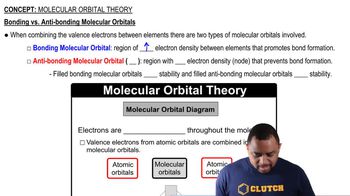
Molecular orbitals (MOs) are formed by the linear combination of atomic orbitals (LCAO) when atoms bond together. In a molecular orbital diagram, these orbitals are depicted based on their energy levels and the number of atomic orbitals involved. Each molecular orbital can hold a maximum of two electrons with opposite spins, and they are categorized as bonding, antibonding, or non-bonding based on their energy and stability.
Video consigliato:
Percorso guidato
03:06
Molecular Orbital Theory

Linear Chains of Atoms

In a linear chain of atoms, such as lithium, the atomic orbitals combine to form molecular orbitals that extend over the entire chain. The number of molecular orbitals produced is equal to the number of atomic orbitals contributed by the atoms in the chain. For a chain of six lithium atoms, each contributing one atomic orbital, there will be six molecular orbitals in total, reflecting the collective behavior of the electrons in the chain.
Video consigliato:

Energy Levels and Orbital Filling

Molecular orbitals are filled according to the Aufbau principle, where lower-energy orbitals are filled before higher-energy ones. The energy levels of the molecular orbitals in a chain can be visualized in a diagram, where bonding orbitals are lower in energy and antibonding orbitals are higher. Understanding how to fill these orbitals helps predict the stability and reactivity of the molecule, as well as the total number of orbitals present in the system.
Video consigliato:
Percorso guidato
04:12
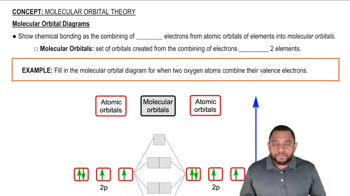
Molecular Orbital Diagram