
Ch.12 - Solids and Modern Materials
Brown - Chemistry: The Central Science 15th Edition
Brown15th EditionChemistry: The Central ScienceISBN: 9780137542970Non è quello che usi tu?Cambia libro di testo
Capitolo 12, Problema 22c

Two patterns of packing two different circles of the same size are shown here. For each structure (c) determine the type of two-dimensional lattice (from Figure 12.4). (i)
Two packing patterns of circles labeled I and II, illustrating crystalline solid structures.


(ii)

Guida verificata passo dopo passo
1
Observe the two packing patterns of circles labeled I and II.
Identify the type of two-dimensional lattice for pattern I. Notice that the circles are arranged in a hexagonal pattern, where each circle is surrounded by six others.
Identify the type of two-dimensional lattice for pattern II. Notice that the circles are arranged in a rectangular pattern, where each circle is surrounded by four others.
Refer to Figure 12.4 in your textbook to match these observations with the corresponding lattice types.
Conclude that pattern I corresponds to a hexagonal lattice and pattern II corresponds to a rectangular lattice.

Risposta video verificata per un problema simile:

Questa soluzione video è stata consigliata dai nostri tutor come utile per risolvere questo problema.
Durata del video:
1m

Concetti chiave

Ecco i concetti essenziali che devi comprendere per rispondere correttamente alla domanda.

Two-Dimensional Lattices

A two-dimensional lattice is a regular arrangement of points in a plane, where each point represents the position of a particle, such as atoms or molecules. The arrangement can be characterized by its symmetry and the shape of the unit cell, which is the smallest repeating unit that defines the entire lattice structure. Common types of two-dimensional lattices include square, rectangular, and hexagonal lattices.
Video consigliato:

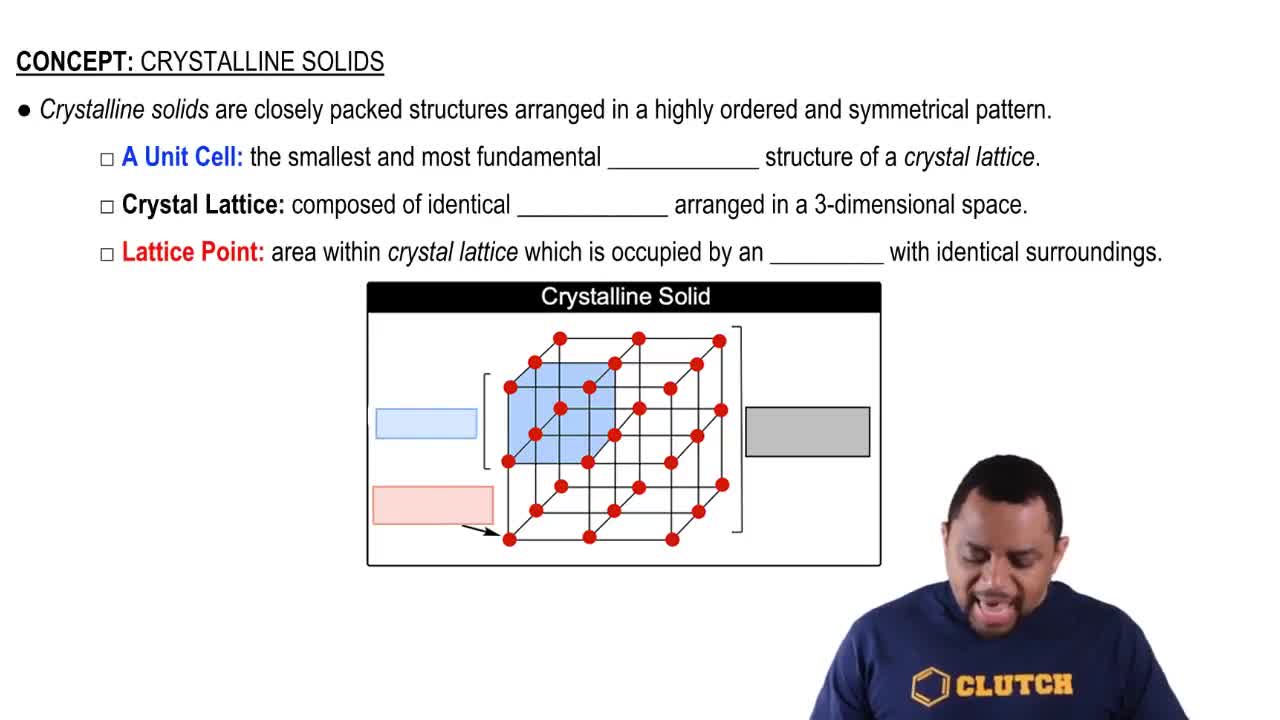
Crystalline Structures

Crystalline structures are ordered arrangements of atoms or molecules in a solid, resulting in distinct geometric shapes. In two dimensions, these structures can be visualized as patterns of circles or spheres that represent the particles. The packing efficiency and arrangement of these particles determine the properties of the material, such as density and stability.
Video consigliato:
Percorso guidato
01:31
Crystalline Solids Structure

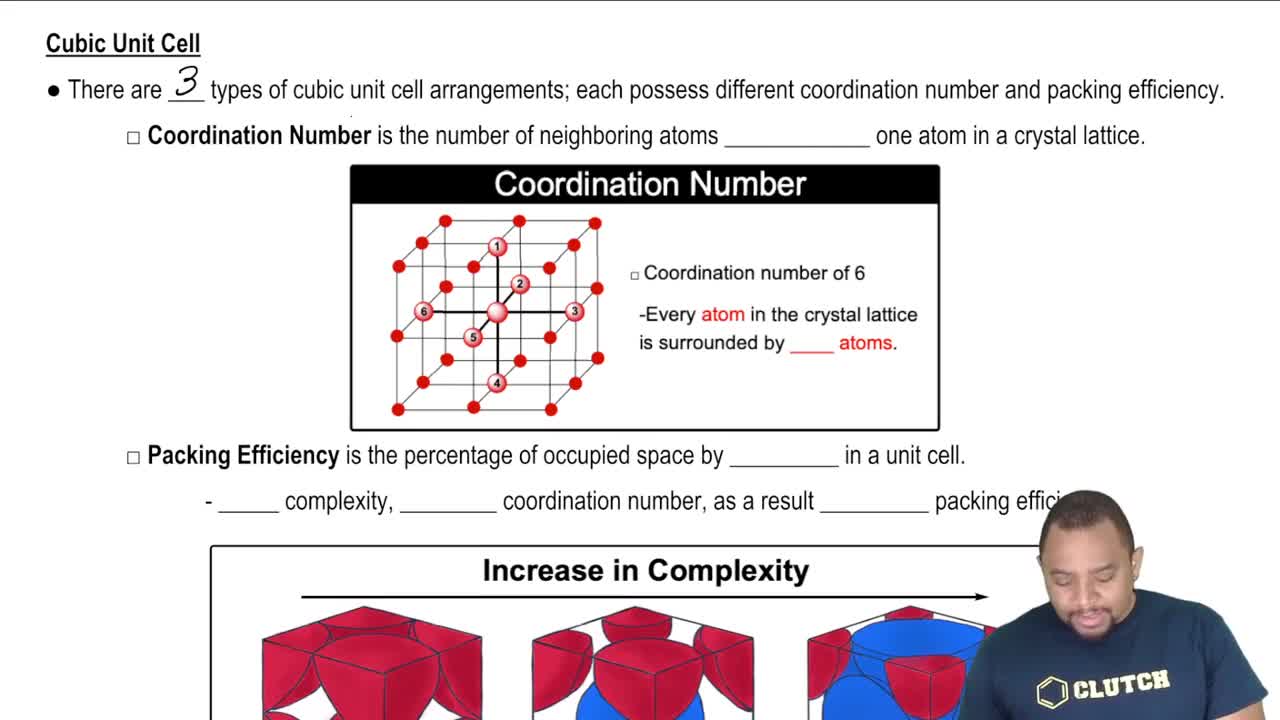
Packing Efficiency

Packing efficiency refers to the fraction of volume in a crystal structure that is occupied by the particles, compared to the total volume of the unit cell. It is a crucial concept in understanding how tightly particles are packed in a lattice. Different packing arrangements, such as close-packed or simple arrangements, lead to varying packing efficiencies, influencing the physical properties of the material.
Video consigliato:
Percorso guidato
01:41
Cubic Unit Cells