Which type (or types) of crystalline solid is characterized by each of the following? (d) network of covalent bonds.
Ch.12 - Solids and Modern Materials

Brown15th EditionChemistry: The Central ScienceISBN: 9780137542970Non è quello che usi tu?Cambia libro di testo
Capitolo 12, Problema 14c
Which type (or types) of crystalline solid is characterized by each of the following? (c) high melting point and poor electrical conductivity;
Guida verificata passo dopo passo1
Identify the types of crystalline solids: molecular, ionic, covalent network, and metallic.
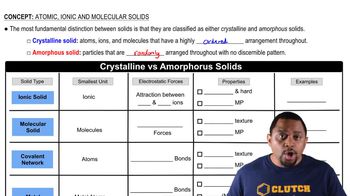
Consider the properties of each type: molecular solids have low melting points and are poor conductors; ionic solids have high melting points and conduct electricity when molten; covalent network solids have high melting points and are poor conductors; metallic solids have variable melting points and are good conductors.
Focus on the given properties: high melting point and poor electrical conductivity.
Match these properties to the type of crystalline solid: covalent network solids are known for having high melting points and being poor conductors of electricity.
Conclude that the type of crystalline solid characterized by a high melting point and poor electrical conductivity is a covalent network solid.

Risposta video verificata per un problema simile:
Questa soluzione video è stata consigliata dai nostri tutor come utile per risolvere questo problema.
Durata del video:
3mConcetti chiave
Ecco i concetti essenziali che devi comprendere per rispondere correttamente alla domanda.
Types of Crystalline Solids
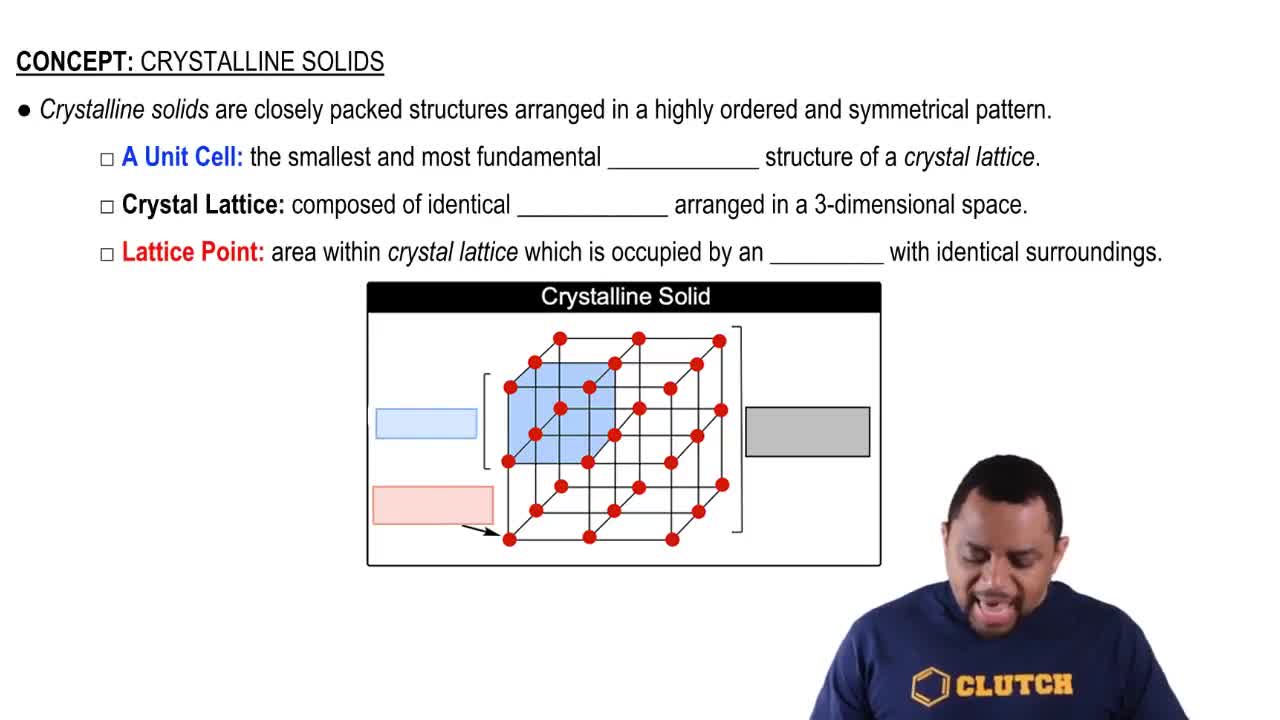
Crystalline solids can be categorized into several types based on the nature of the bonding and the arrangement of their constituent particles. The main types include ionic, covalent network, metallic, and molecular solids. Each type exhibits distinct physical properties, such as melting points and electrical conductivity, which are influenced by the strength and type of interactions between the particles.
Video consigliato:
Percorso guidato
Crystalline Solids Structure
Ionic Solids
Ionic solids are formed from the electrostatic attraction between positively and negatively charged ions. They typically have high melting points due to the strong ionic bonds that require significant energy to break. However, in their solid state, ionic solids do not conduct electricity, as the ions are fixed in place and cannot move freely, making them poor electrical conductors.
Video consigliato:
Percorso guidato
Ionic Solid Identification Example
Covalent Network Solids
Covalent network solids consist of atoms connected by a network of covalent bonds, forming a rigid structure. Examples include diamond and silicon carbide, which exhibit very high melting points due to the strength of the covalent bonds. Like ionic solids, covalent network solids also lack free-moving charged particles in their solid state, resulting in poor electrical conductivity.
Video consigliato:
Percorso guidato
Crystalline vs Amorphous Solids
Pratica correlata
Domanda del libro di testo
710
views
Domanda del libro di testo
Which type (or types) of crystalline solid is characterized by each of the following? (a) High mobility of electrons throughout the solid;
1063
views
Domanda del libro di testo
Which type (or types) of crystalline solid is characterized by each of the following? (b) softness, relatively low melting point;
781
views
Domanda del libro di testo
You are given a gray substance that melts at 700 °C; the solid is a conductor of electricity and is insoluble in water. Which type of solid (molecular, metallic, covalent-network, or ionic) might this substance be?
501
views
Domanda del libro di testo
Indicate the type of solid (molecular, metallic, ionic, or covalent-network) for each compound: (c) Ta2O5 (melting point, 1872°C)
1258
views
Domanda del libro di testo
What kinds of attractive forces exist between particles (atoms, molecules, or ions) in (d) and metallic crystals?
520
views