
Ch.13 - Properties of Solutions
Brown - Chemistry: The Central Science 15th Edition
Brown15th EditionChemistry: The Central ScienceISBN: 9780137542970Non è quello che usi tu?Cambia libro di testo
Capitolo 13, Problema 62

Assume that a portable reverse-osmosis apparatus operates on seawater, whose effective concentration (the concentration of dissolved ions) is 1.12 M, and that the desalinated water output has an effective molarity of about 0.02 M. What minimum pressure must be applied by hand pumping at 297 K to cause reverse osmosis to occur?

Guida verificata passo dopo passo
1
Identify the formula for osmotic pressure: \( \pi = iMRT \), where \( i \) is the van't Hoff factor, \( M \) is the molarity, \( R \) is the ideal gas constant, and \( T \) is the temperature in Kelvin.
Determine the van't Hoff factor \( i \) for seawater. Since seawater contains a mixture of ions, assume \( i \approx 2 \) for simplicity.
Calculate the osmotic pressure of seawater using its molarity (1.12 M) and the given temperature (297 K). Use \( R = 0.0821 \text{ L atm K}^{-1} \text{ mol}^{-1} \).
Calculate the osmotic pressure of the desalinated water using its molarity (0.02 M) and the same temperature.
Find the minimum pressure required for reverse osmosis by subtracting the osmotic pressure of the desalinated water from that of the seawater.

Risposta video verificata per un problema simile:

Questa soluzione video è stata consigliata dai nostri tutor come utile per risolvere questo problema.
Durata del video:
2m

Concetti chiave

Ecco i concetti essenziali che devi comprendere per rispondere correttamente alla domanda.

Reverse Osmosis

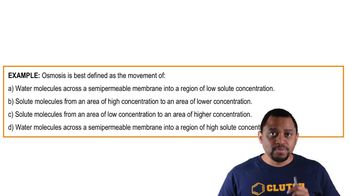
Reverse osmosis is a water purification process that uses a semipermeable membrane to remove ions, molecules, and larger particles from drinking water. In this process, pressure is applied to overcome osmotic pressure, allowing water to flow from a region of higher solute concentration (seawater) to a region of lower solute concentration (desalinated water). This is essential for understanding how to calculate the pressure needed for desalination.
Video consigliato:
Percorso guidato
00:38
Osmosis Example

Osmotic Pressure

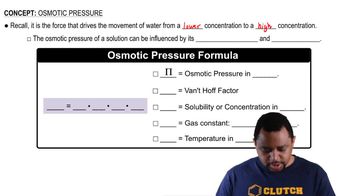
Osmotic pressure is the pressure required to stop the flow of solvent into a solution through a semipermeable membrane. It can be calculated using the formula π = iCRT, where π is the osmotic pressure, i is the van 't Hoff factor, C is the molarity of the solution, R is the ideal gas constant, and T is the temperature in Kelvin. This concept is crucial for determining the minimum pressure needed to achieve reverse osmosis.
Video consigliato:
Percorso guidato
01:13
Osmotic Pressure Formula

Ideal Gas Constant

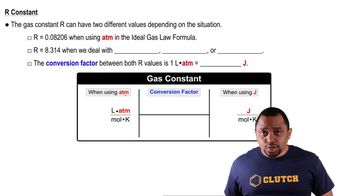
The ideal gas constant (R) is a fundamental constant used in various equations in chemistry, including those related to gas laws and osmotic pressure. Its value is typically 0.0821 L·atm/(K·mol) or 8.314 J/(K·mol). Understanding this constant is important for calculating osmotic pressure and, consequently, the pressure required for reverse osmosis in the given scenario.
Video consigliato:
Percorso guidato
01:56
Gas Constant Values