List the following aqueous solutions in order of increasing boiling point: 0.120 m glucose, 0.050 m LiBr, 0.050 m Zn(NO3)2.
Ch.13 - Properties of Solutions

Brown15th EditionChemistry: The Central ScienceISBN: 9780137542970Non è quello che usi tu?Cambia libro di testo
Capitolo 13, Problema 69c
At 63.5 °C, the vapor pressure of H2O is 175 torr, and that of ethanol (C2H5OH) is 400 torr. A solution is made by mixing equal masses of H2O and C2H5OH. (a) What is the composition in mole fraction of a solution that has a vapor pressure of 35 torr at 20 °C?
Guida verificata passo dopo passo1
First, calculate the number of moles of H2O and C2H5OH in the solution. Use the formula: \( n = \frac{m}{M} \), where \( n \) is the number of moles, \( m \) is the mass, and \( M \) is the molar mass. The molar mass of H2O is approximately 18.02 g/mol, and for C2H5OH, it is approximately 46.08 g/mol.
Since the masses of H2O and C2H5OH are equal, assume a mass \( m \) for each. Calculate the moles of each component using their respective molar masses.
Determine the mole fraction of each component. The mole fraction \( X_i \) is given by \( X_i = \frac{n_i}{n_{total}} \), where \( n_i \) is the number of moles of component \( i \) and \( n_{total} \) is the total number of moles in the solution.
Apply Raoult's Law to find the partial vapor pressures of each component in the solution. Raoult's Law states that the partial vapor pressure of a component in a solution is equal to the mole fraction of the component multiplied by the vapor pressure of the pure component: \( P_i = X_i \cdot P_i^0 \), where \( P_i^0 \) is the vapor pressure of the pure component.
The total vapor pressure of the solution is the sum of the partial pressures of each component: \( P_{total} = P_{H2O} + P_{C2H5OH} \). Set this equal to the given vapor pressure of 35 torr and solve for the mole fractions.
Concetti chiave
Ecco i concetti essenziali che devi comprendere per rispondere correttamente alla domanda.
Vapor Pressure
Vapor pressure is the pressure exerted by a vapor in equilibrium with its liquid or solid phase at a given temperature. It reflects the tendency of particles to escape from the liquid phase into the vapor phase. The higher the vapor pressure, the more volatile the substance. Understanding vapor pressure is crucial for predicting how mixtures behave when components are combined.
Video consigliato:
Percorso guidato
Raoult's Law and Vapor Pressure
Raoult's Law
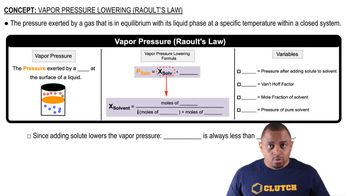
Raoult's Law states that the vapor pressure of a solvent in a solution is directly proportional to the mole fraction of the solvent present. This law is fundamental in determining the vapor pressures of components in a mixture and is essential for calculating the overall vapor pressure of a solution. It helps in understanding how the addition of a solute affects the vapor pressure of the solvent.
Video consigliato:
Percorso guidato
Raoult's Law and Vapor Pressure
Mole Fraction
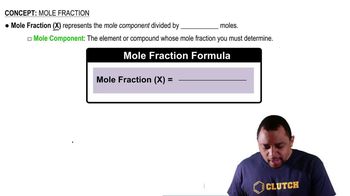
Mole fraction is a way of expressing the concentration of a component in a mixture, defined as the number of moles of that component divided by the total number of moles of all components in the mixture. It is a dimensionless quantity that provides insight into the composition of solutions. In the context of vapor pressure, mole fractions are used to apply Raoult's Law to find the vapor pressures of individual components.
Video consigliato:
Percorso guidato
Mole Fraction Formula
Pratica correlata
Domanda del libro di testo
1410
views
Domanda del libro di testo
At 63.5 °C, the vapor pressure of H2O is 175 torr, and that of ethanol (C2H5OH) is 400 torr. A solution is made by mixing equal masses of H2O and C2H5OH. (a) What is the mole fraction of ethanol in the solution?
2061
views
Domanda del libro di testo
At 63.5 °C, the vapor pressure of H2O is 175 torr, and that of ethanol (C2H5OH) is 400 torr. A solution is made by mixing equal masses of H2O and C2H5OH. (b) Assuming ideal solution behavior, what is the vapor pressure of the solution at 63.5 °C?
703
views
Domanda del libro di testo
At 20 °C, the vapor pressure of benzene (C6H6) is 75 torr, and that of toluene (C7H8) is 22 torr. Assume that benzene and toluene form an ideal solution. (b) What is the mole fraction of benzene in the vapor above the solution described in part (a)?
2271
views
1
comments