Ch.13 - Properties of Solutions
Brown - Chemistry: The Central Science 15th Edition
Brown15th EditionChemistry: The Central ScienceISBN: 9780137542970Non è quello che usi tu?Cambia libro di testo
Capitolo 13, Problema 29

Common laboratory solvents include acetone (CH3COCH3), methanol (CH3OH), toluene (C6H5CH3), and water. Which of these is the best solvent for nonpolar solutes?

Guida verificata passo dopo passo
1
Step 1: Understand the concept of polarity. Polarity in chemistry refers to the distribution of electric charge around atoms, chemical groups, or molecules. Polar molecules have a significant difference in electronegativity between their atoms, leading to a dipole moment.
Step 2: Recall the principle 'like dissolves like'. This principle suggests that polar solvents are good at dissolving polar solutes, and nonpolar solvents are good at dissolving nonpolar solutes.
Step 3: Identify the polarity of each solvent. Acetone (CH3COCH3) is polar due to its carbonyl group. Methanol (CH3OH) is polar because of its hydroxyl group. Toluene (C6H5CH3) is nonpolar due to its hydrocarbon structure. Water is highly polar due to its bent shape and hydrogen bonding.
Step 4: Determine which solvent is nonpolar. Based on the structures, toluene (C6H5CH3) is the nonpolar solvent among the options provided.
Step 5: Conclude that toluene is the best solvent for nonpolar solutes, as it shares similar nonpolar characteristics, allowing it to effectively dissolve nonpolar substances.

Concetti chiave

Ecco i concetti essenziali che devi comprendere per rispondere correttamente alla domanda.

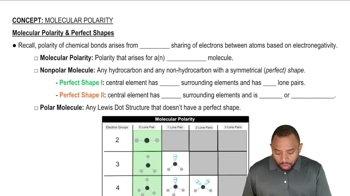
Polarity of Solvents

Polarity refers to the distribution of electrical charge over the atoms in a molecule. Polar solvents, like water and methanol, have a significant difference in electronegativity between their atoms, leading to a dipole moment. Nonpolar solvents, such as toluene and acetone, have a more even distribution of charge, making them better suited for dissolving nonpolar solutes.
Video consigliato:
Percorso guidato
02:38
Molecular Polarity

Like Dissolves Like

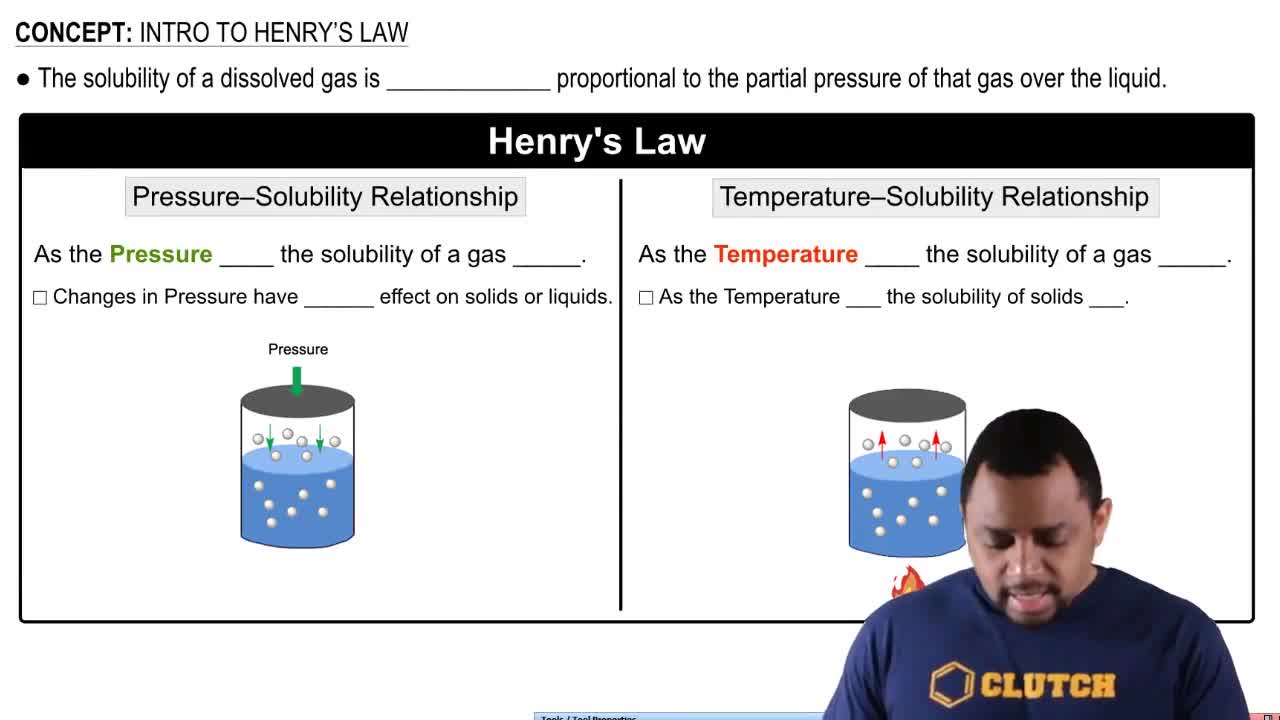
The principle of 'like dissolves like' states that polar solvents are effective at dissolving polar solutes, while nonpolar solvents are better for nonpolar solutes. This concept is crucial in predicting solubility and understanding solvent-solute interactions, as the molecular structure and polarity of both the solvent and solute determine their compatibility.
Video consigliato:
Percorso guidato
02:14
Henry's Law Solubility

Solvent Properties

Different solvents have unique properties that affect their ability to dissolve various substances. For instance, toluene is a nonpolar solvent with a low dielectric constant, making it effective for dissolving nonpolar compounds. Understanding the properties of solvents, including their polarity, boiling points, and molecular structure, is essential for selecting the appropriate solvent for a given solute.
Video consigliato:
Percorso guidato
02:49
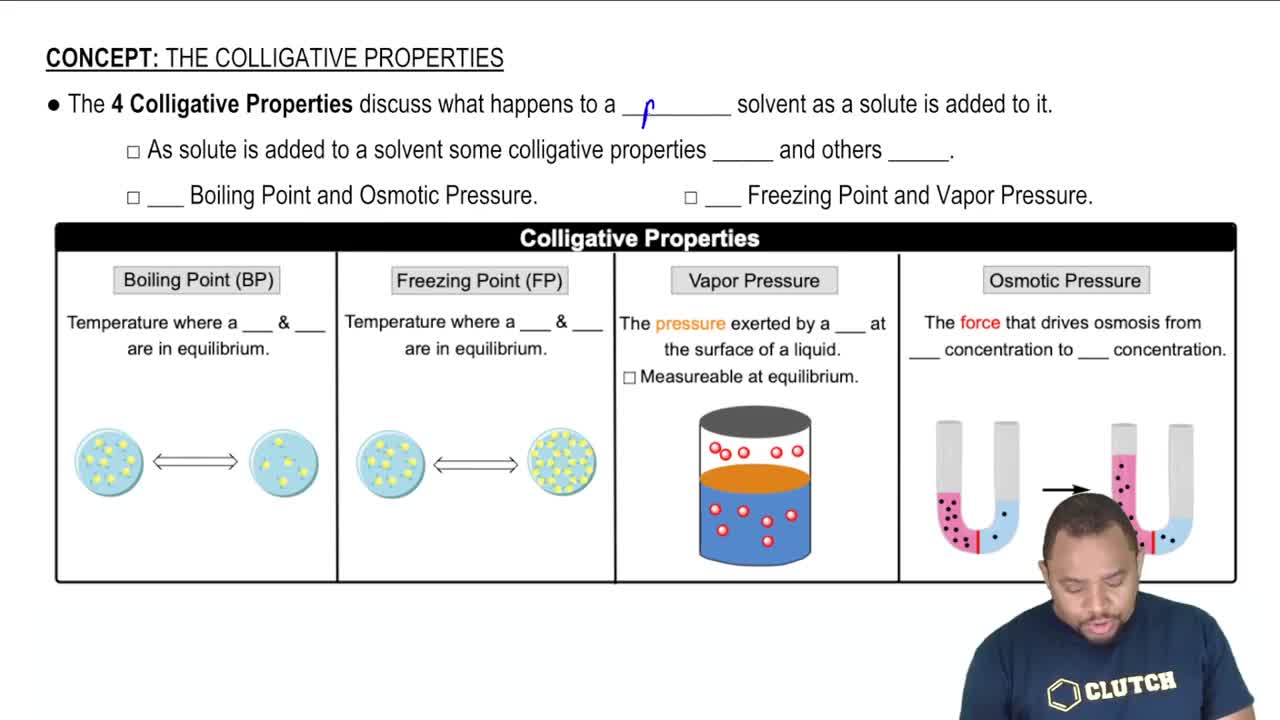
Colligative Properties