Ch.13 - Properties of Solutions
Brown - Chemistry: The Central Science 15th Edition
Brown15th EditionChemistry: The Central ScienceISBN: 9780137542970Non è quello che usi tu?Cambia libro di testo
Capitolo 13, Problema 22

KBr is relatively soluble in water, yet its enthalpy of solution is + 19.8 kJ/mol. Which of the following statements provides the best explanation for this behavior? (a) Potassium salts are always soluble in water. (b) The entropy of mixing must be unfavorable. (c) The enthalpy of mixing must be small compared to the enthalpies for breaking up water–water interactions and K–Br ionic interactions. (d) KBr has a high molar mass compared to other salts like NaCl.

Guida verificata passo dopo passo
1
Identify the key concept: The enthalpy of solution is positive, indicating that the process is endothermic, meaning it absorbs heat.
Consider the solubility: Despite the positive enthalpy of solution, KBr is still soluble in water, suggesting that another factor, such as entropy, plays a significant role.
Evaluate the options: (a) Potassium salts are generally soluble, but this does not explain the positive enthalpy. (b) An unfavorable entropy of mixing would not support solubility. (c) A small enthalpy of mixing compared to the energy required to break water-water and K-Br interactions suggests that entropy compensates for the endothermic process. (d) Molar mass does not directly affect solubility in this context.
Focus on entropy: The dissolution process likely has a favorable entropy change, which can drive the solubility despite the endothermic nature of the process.
Select the best explanation: Option (c) is the most plausible, as it accounts for the positive enthalpy of solution and the solubility of KBr by suggesting that the entropy change is favorable enough to overcome the enthalpy barrier.

Risposta video verificata per un problema simile:

Questa soluzione video è stata consigliata dai nostri tutor come utile per risolvere questo problema.
Durata del video:
1m

Concetti chiave

Ecco i concetti essenziali che devi comprendere per rispondere correttamente alla domanda.

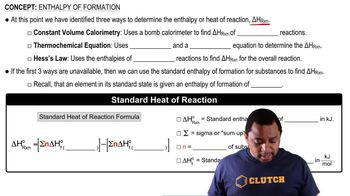
Enthalpy of Solution

The enthalpy of solution refers to the heat change that occurs when a solute dissolves in a solvent. A positive enthalpy of solution, like the +19.8 kJ/mol for KBr, indicates that the process is endothermic, meaning it absorbs heat from the surroundings. This can suggest that the interactions between the solute and solvent are not strong enough to compensate for the energy required to break the solute's ionic bonds and the solvent's intermolecular forces.
Video consigliato:
Percorso guidato
02:34
Enthalpy of Formation

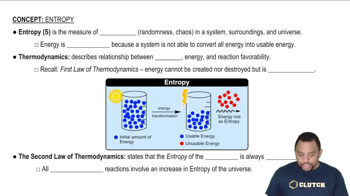
Entropy and Mixing

Entropy is a measure of disorder or randomness in a system. When a solute dissolves, the mixing of solute and solvent generally increases entropy, favoring dissolution. However, if the entropy of mixing is unfavorable, it can counteract the enthalpic contributions, making dissolution less favorable despite the solute's solubility. Understanding the balance between enthalpy and entropy is crucial in predicting solubility behavior.
Video consigliato:
Percorso guidato
02:46
Entropy in Thermodynamics

Ionic Interactions

Ionic interactions are the forces that hold ionic compounds together, such as the attraction between K+ and Br- ions in KBr. When KBr dissolves, these ionic bonds must be broken, which requires energy. If the energy released from the formation of new interactions between KBr and water molecules is less than the energy needed to break the original ionic and water-water interactions, the dissolution process will be endothermic, as indicated by the positive enthalpy of solution.
Video consigliato: