
Using data from Table 13.3, calculate the freezing and boiling points of each of the following solutions: (a) 0.22 m glycerol (C3H8O3) in ethanol, (b) 0.240 mol of naphthalene (C10H8) in 2.45 mol of chloroform, (c) 1.50 g NaCl in 0.250 kg of water, (d) 2.04 g KBr and 4.82 g of glucose (C6H12O6) in 188 g of water.
Ch.13 - Properties of Solutions

Brown15th EditionChemistry: The Central ScienceISBN: 9780137542970Non è quello che usi tu?Cambia libro di testo
Capitolo 13, Problema 73
List the following aqueous solutions in order of increasing boiling point: 0.120 m glucose, 0.050 m LiBr, 0.050 m Zn(NO3)2.
Guida verificata passo dopo passo1
Identify the colligative property involved: Boiling point elevation is a colligative property, which depends on the number of solute particles in a solution.
Determine the van 't Hoff factor (i) for each solute: Glucose (C_6H_{12}O_6) is a non-electrolyte, so i = 1. LiBr is an electrolyte that dissociates into Li^+ and Br^-, so i = 2. Zn(NO_3)_2 dissociates into Zn^{2+} and 2 NO_3^-, so i = 3.
Calculate the effective molality for each solution: Multiply the molality (m) by the van 't Hoff factor (i) for each solution. For glucose, it's 0.120 m * 1. For LiBr, it's 0.050 m * 2. For Zn(NO_3)_2, it's 0.050 m * 3.
Compare the effective molalities: The solution with the highest effective molality will have the highest boiling point, and the one with the lowest effective molality will have the lowest boiling point.
List the solutions in order of increasing boiling point based on their effective molalities.

Risposta video verificata per un problema simile:
Questa soluzione video è stata consigliata dai nostri tutor come utile per risolvere questo problema.
Durata del video:
3mConcetti chiave
Ecco i concetti essenziali che devi comprendere per rispondere correttamente alla domanda.
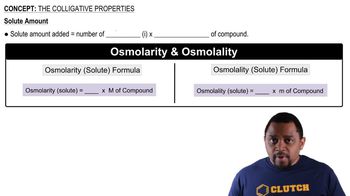
Colligative Properties
Colligative properties are physical properties of solutions that depend on the number of solute particles in a given amount of solvent, rather than the identity of the solute. These properties include boiling point elevation, freezing point depression, vapor pressure lowering, and osmotic pressure. In this context, the boiling point elevation is crucial for determining the order of the solutions based on their molal concentrations.
Video consigliato:
Percorso guidato
Colligative Properties
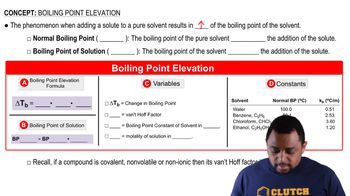
Boiling Point Elevation
Boiling point elevation occurs when a non-volatile solute is added to a solvent, resulting in an increase in the boiling point of the solution compared to the pure solvent. The extent of this elevation is directly proportional to the molality of the solute and the van 't Hoff factor (i), which accounts for the number of particles the solute dissociates into. Thus, solutions with higher concentrations of solute particles will have higher boiling points.
Video consigliato:
Percorso guidato
Boiling Point Elevation
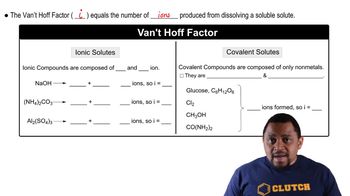
Van 't Hoff Factor (i)
The van 't Hoff factor (i) represents the number of particles into which a solute dissociates in solution. For example, glucose does not dissociate (i=1), while LiBr dissociates into two ions (Li+ and Br-, i=2), and Zn(NO3)2 dissociates into three ions (Zn2+ and two NO3-, i=3). This factor is essential for calculating the effective concentration of solute particles, which influences the boiling point elevation of the solution.
Video consigliato:
Percorso guidato
Van't Hoff Factor
Pratica correlata
Domanda del libro di testo
1130
views
Domanda del libro di testo
At 20 °C, the vapor pressure of benzene (C6H6) is 75 torr, and that of toluene (C7H8) is 22 torr. Assume that benzene and toluene form an ideal solution. (b) What is the mole fraction of benzene in the vapor above the solution described in part (a)?
2271
views
1
comments
Domanda del libro di testo
Using data from Table 13.3, calculate the freezing and boiling points of each of the following solutions: (a) 0.25 m glucose in ethanol; (b) 20.0 g of decane, C10H22, in 50.0 g CHCl3; (c) 3.50 g NaOH in 175 g of water, (d) 0.45 mol ethylene glycol and 0.15 mol KBr in 150 g H2O.
1576
views
