
Ch.14 - Chemical Kinetics
Brown - Chemistry: The Central Science 15th Edition
Brown15th EditionChemistry: The Central ScienceISBN: 9780137542970Non è quello che usi tu?Cambia libro di testo
Capitolo 14, Problema 12d

Consider the diagram that follows, which represents two steps in an overall reaction. The red spheres are oxygen, the blue ones are nitrogen, and the green ones are fluorine. d. Write the rate law for the overall reaction if the first step is the slow, rate-determining step. [Section 14.5]

Guida verificata passo dopo passo
1
Identify the reactants involved in the slow, rate-determining step.
Determine the molecularity of the slow step by counting the number of reactant molecules involved.
Write the rate law based on the molecularity of the slow step, using the concentrations of the reactants.
Express the rate law in the form: rate = k [A]^m [B]^n, where A and B are reactants, and m and n are their respective orders.
Remember that the rate law for the overall reaction is determined by the rate law of the slowest step in the mechanism.

Risposta video verificata per un problema simile:

Questa soluzione video è stata consigliata dai nostri tutor come utile per risolvere questo problema.
Durata del video:
2m

Concetti chiave

Ecco i concetti essenziali che devi comprendere per rispondere correttamente alla domanda.

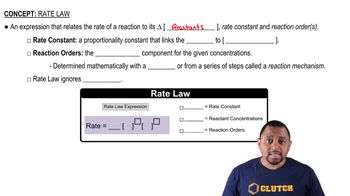
Rate Law

The rate law is an equation that relates the rate of a chemical reaction to the concentration of its reactants. It is typically expressed in the form rate = k[A]^m[B]^n, where k is the rate constant, [A] and [B] are the concentrations of the reactants, and m and n are the reaction orders. Understanding the rate law is crucial for predicting how changes in concentration affect the reaction rate.
Video consigliato:
Percorso guidato
01:52
Rate Law Fundamentals

Rate-Determining Step

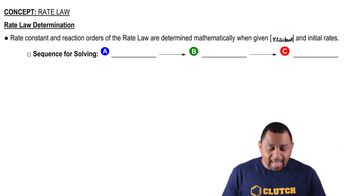
The rate-determining step is the slowest step in a multi-step reaction mechanism, which limits the overall reaction rate. This step dictates the kinetics of the entire reaction, and its rate law can be used to derive the overall rate law. Identifying the rate-determining step is essential for accurately writing the rate law for complex reactions.
Video consigliato:
Percorso guidato
01:15
Rate Law Determination

Reaction Mechanism

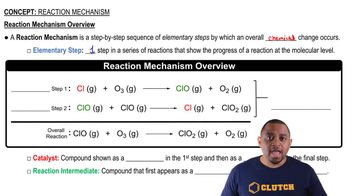
A reaction mechanism is a detailed description of the individual steps that occur during a chemical reaction. Each step involves the breaking and forming of bonds, and the mechanism provides insight into how reactants are converted into products. Understanding the mechanism is vital for determining which step is rate-determining and for writing the correct rate law.
Video consigliato:
Percorso guidato
03:06
Reaction Mechanism Overview